 |
|
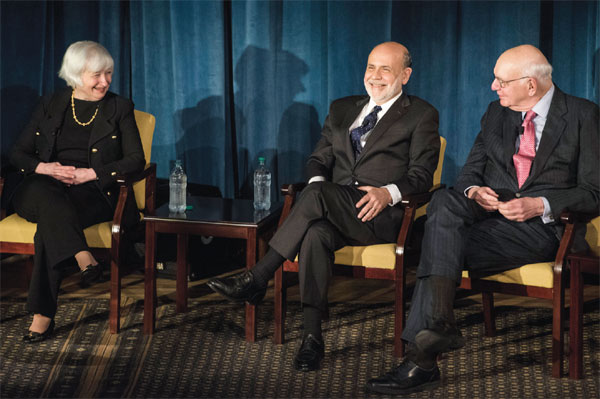
From left: Federal Reserve Chair Janet Yellen, and former Fed chairmen Ben Bernanke and Paul Volcker share a laugh during a panel discussion at the International House in New York on Thursday. [Photo / AFP] |
The final day of the summer marked the start of yet another season of futile policymaking by two of the world's major central banks-US Federal Reserve and Bank of Japan. The Fed did nothing, which is precisely the problem. And the alchemists at the BOJ unveiled yet another feeble unconventional policy gambit.
Both the Fed and the BOJ are pursuing strategies that are woefully disconnected from the economies they have been entrusted to manage. Moreover, their latest actions reinforce a deepening commitment to an increasingly insidious transmission mechanism between monetary policy, financial markets and asset-dependent economies. This approach led to the meltdown of 2008-09, and it could well sow the seeds of another crisis in the years ahead.
Lost in the debate over the efficacy of the new and powerful tools that central bankers have added to their arsenal is the harsh reality of anemic economic growth. Japan is an obvious case in point. Stuck in what has been essentially a 1 percent growth trajectory for the last quarter-century, its economy has failed to respond to repeated efforts at extraordinary monetary stimulus.
Whatever the acronym-first, ZIRP (the zero interest-rate policy of the late 1990s), then QQE (the qualitative and quantitative easing launched by the BOJ in 2013), and now NIRP (the recent move to a negative interest-rate policy)-the BOJ has over-promised and under-delivered. In fact, with Japan's real annual GDP growth slipping to 0.6 percent since Shinzo Abe was elected prime minister in late 2012-one-third slower than the sluggish 0.9 percent average annual rate over the preceding 22 lost years (1991 to 2012)-the so-called maximum stimulus of "Abenomics" has been an abject failure.
The Fed hasn't fared much better. Real GDP growth in the United States has averaged only 2.1 percent in the 28 quarters since the Great Recession ended in the third quarter of 2009-barely half the 4 percent average pace in comparable periods of earlier upturns.
Notwithstanding the persistent growth shortfall, central bankers remain steadfast that their approach is working, by delivering what they call "mandate-compliant" outcomes. The Fed points to the sharp reduction of the US unemployment rate-from 10 percent in October 2009 to 4.9 percent today-as prima facie evidence of an economy that is nearing one of the targets of the Fed's so-called dual mandate.
But when seemingly solid employment growth is juxtaposed against weak output, the story unravels, revealing a major productivity slowdown that raises serious questions about the US' long-term growth potential and an eventual buildup of cost and inflationary pressures.
While policy traction has been notably absent in the real economies of both Japan and the US, asset markets are a different story. Equities and bonds have soared on the back of monetary policies that have led to rock-bottom interest rates and massive liquidity injections.
The new unconventional monetary policies in both countries are obviously missing the disconnect between asset markets and real economic activity.
What is particularly disconcerting is that central bankers remain largely in denial in the face of this painful reality check.
Having depleted their traditional arsenal long ago, central bankers remain myopically focused on devising new tools, rather than owning up to the destructive role their old tools played in sparking the crisis.
While financial markets love any form of monetary accommodation, there can be no mistaking its dark side. Asset prices are being manipulated across the board-stocks and bonds, long- and short-duration assets, as well as currencies. As a result, savers are being punished, the cost of capital is repressed, and reckless risk taking is being encouraged in an income-constrained climate. This is especially treacherous terrain for economies desperately in need of productivity-enhancing investment. And it is not dissimilar to the environment of asset-based excess that incubated the 2008-09 global financial crisis.
Moreover, frothy asset markets in an era of extreme monetary accommodation take the pressure off fiscal authorities to act. Failing to heed one of the most powerful (yes, Keynesian) lessons of the 1930s-that fiscal policy is the only way out of a liquidity trap-could be the greatest tragedy of all. Central bankers desperately want the public to believe that they know what they are doing. Nothing could be further from the truth.
The author, a faculty member at Yale University and former chairman of Morgan Stanley Asia, is the author of Unbalanced: The Codependency of America and China.
Project Syndicate


Copyright 1995 - . All rights reserved. The content (including but not limited to text, photo, multimedia information, etc) published in this site belongs to China Daily Information Co (CDIC). Without written authorization from CDIC, such content shall not be republished or used in any form. Note: Browsers with 1024*768 or higher resolution are suggested for this site.
License for publishing multimedia online 0108263 Registration Number: 130349