How to fight antimicrobial resistance globally
 |
|
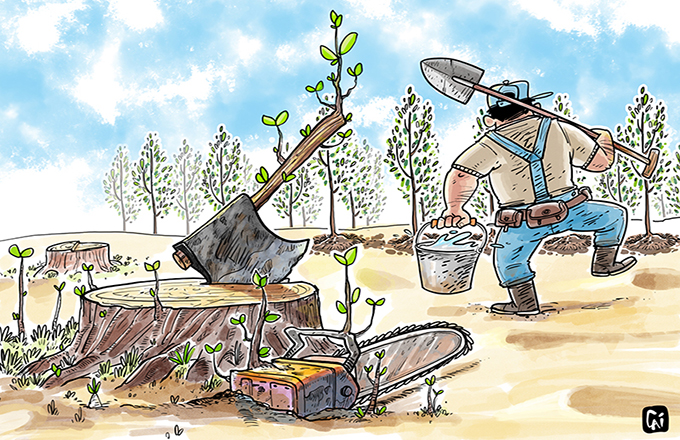
LUO JIE/CHINA DAILY |
The threat is straightforward: bacteria and other microbes are becoming resistant to available medicines faster than new medicines are being developed. Every year, drug-resistant microbes kill about 700,000 people worldwide-more than three times the annual death toll from armed conflicts.
Last year, a special panel commissioned by the British government predicted that, by 2050, as many as 10 million more people will die from drug-resistant microbes every year. AMR now poses a clear danger to every person on the planet. Unless we confront it head-on, we could return to a world in which it is common for people to die from basic infections.
Beyond the cost in human lives, AMR could devastate the world's economies. In Europe alone, the annual healthcare costs and productivity losses associated with AMR already total about 1.5 billion euros ($1.7 billion).
The G20, for its part, has taken an important step forward: each G20 country has promised to start implementing national plans to fight AMR in earnest, and to do more to promote new treatments against resistant microbes. To that end, G20 leaders are calling for an international "research and development collaboration hub" to "maximize the impact of existing and new anti-microbial basic and clinical research initiatives". And they have promised to explore how market incentives can be used to encourage new research.
Beyond the G20, innovative public-private partnerships are emerging to deliver new treatments against drug-resistant killers such as tuberculosis. And some governments have already started filling critical roles in the global response to AMR, by collecting data on the spread of resistant strains of E. coli, salmonella and other common pathogens.
Now it is up to political leaders to follow through on their commitments. Because new treatments for multidrug-resistant microbes aren't expected to generate much return on investment, it is incumbent upon governments to make research and development in this field more attractive to private companies, and, in order to stem the development of resistance, to ensure that new drugs are not overused.
Besides, more well-funded collaborations between governments and private institutions are needed. When private institutions enter into such collaborative efforts, they must be prepared to work outside of traditional boundaries, accept the challenges associated with complex public projects, and be willing to bring their skills, ideas and experience to the table.
In responding to AMR, we can learn some valuable lessons from other global public health efforts. Malaria, which is caused by a parasite transmitted by more than 100 species of Anopheles mosquito, is a leading cause of death in many parts of the world. But its death toll has been halved over the last 15 years thanks to the high priority accorded to fighting the disease by many governments and private institutions.
Still, the parasite that causes malaria is developing resistance to artemisinin, which forms the basis for the most effective treatment: artemisinin-based combination therapies. Artemisinin resistance first emerged in Cambodia just over a decade ago, and has since spread through Thailand, Laos, Vietnam, Myanmar and China. It is now approaching India, and experts fear it will eventually reach Africa. According to one recent study, if artemisinin resistance is allowed to spread, malaria will kill at least 116,000 more people every year.
Unless new treatments become available, the tremendous progress that the world has made against malaria will have been tragically short-lived. Fortunately, those engaged in the global response to malaria recognize that just as parasites are adapting to new situations, so must we. New efforts are underway to identify and minimize the spread of resistant malaria, while simultaneously developing new artemisinin-free treatments.
For example, the Regional Artemisinin-Resistance Initiative is working to halt the spread of resistant malaria in the Mekong Delta region, by monitoring and sharing drug-resistance data and promoting proper use of antimalarial treatments. So far, the initiative has secured $128.65 million through the Global Fund to Fight AIDS, Tuberculosis and Malaria, which is financed primarily by governments.
Moreover, Novartis and the Medicines for Malaria Venture (with support from the Bill & Melinda Gates Foundation) are starting a new clinical trial next month to test KAF156, a molecule that could form the basis of a new treatment against artemisinin-resistant malaria strains.
At last year's World Economic Forum in Davos, Switzerland, 100 companies (including Novartis) and industry associations signed the Davos Declaration on AMR. Under that commitment, we promised to work together with governments to slow the development of resistance, by increasing our investments in research and development and making high-quality antibiotics available to patients who need them.
The G20's national action plans will, we hope, help us to meet these commitments. But political leaders, too, must marshal the will to turn words into action. We urgently need more resources to monitor resistance, stronger incentives for R&D, and innovative financing mechanisms to ensure widespread access to accurate diagnoses and quality medicines.
The world cannot afford to lose the fight against AMR. Winning it will require large-scale public-private cooperation, underpinned by political leadership that makes global public health a top priority.
The author is chairman of the Novartis board of directors. Project Syndicate