Culture a catalyst to national rejuvenation
 |
|
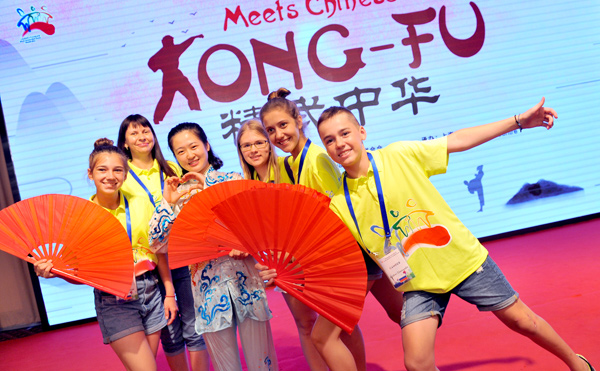
Teenagers from 23 countries take part in a series of activities, such as dragon boat racing, viewing Peking Opera performances and visiting the Shanghai Zoo, that are aimed at strengthening friendships between nations and enhancing cultural communication.[Photos by Lin Chunyue/For chinadaily.com.cn] |
Culture sometimes helps distinguish civilizations from less complex societies. Many sociologists and anthropologists identify culture with civilization. And all of them agree that cultures, both elite and folk, have played a key role in the progress of human civilization.
In China, culture is the source of self-confidence for every citizen, and to strengthen people's confidence in our culture and shape the nation's future, we need to dig deep into our traditional culture.
Our culture has inspired us to pursue the rejuvenation of the Chinese nation, in order to build a strong and prosperous society. To be sure, China has already made great progress toward achieving this goal thanks to its fast-paced modernization. And although China has no intention of becoming the "celestial empire" of the past, traditional culture continues to play a significant role in contemporary society.
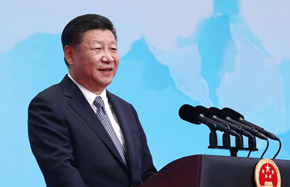
The critical factor that distinguishes China from the rest of the world is not only its hard power, but also its soft power, which has its roots in traditional culture. In fact, delivering a speech at Peking University on May 4, 2015, President Xi Jinping stressed: "We the Chinese have our own unique spiritual world." And this "unique spiritual world" of ours is more of a cultural concept than a geographical concept.
As Confucian scholar Tu Weiming has said in Cultural China: The Periphery as the Center: "China, one of the longest continuous civilizations in human history, may be visualized as a majestic flowing stream. Chinese culture, the generic term symbolizing the vicissitudes of the material and spiritual accomplishments of the Chinese people, has undergone major interpretive phases in recent decades and is now entering a new era of critical reflection. The meaning of being Chinese is intertwined with China as geopolitical concept and Chinese culture as a living reality."
A centripetal force connects the Chinese people, because they share the same spirituality and beliefs, which are irreplaceable cultural aspects of a civilization.
If according to Max Weber, in The Protestant Ethic and the Spirit of Capitalism, the combination of Protestant work ethic and the spirit of capitalism formulated the cultural code fostering the rise of the West, what is the cultural code inspiring China's development? The answer is advanced socialist culture, which combines the strengths of human civilization and has the potential to meet the demands of the times.
The spirit of humanism and morality is the lifeblood of Chinese culture. Old Chinese proverbs, such as "every man alive has a duty toward his country", reflect patriotism, Confucian exhortations, such as "being vigorous and promising", show the striving spirit, and modern "sayings", such as "harmony but not sameness" and "advance with the times and keep improving through reforms", provide the basic principles-and the wisdom of reform-to deal with different cultures in the world.
It is with these spirits that the Communist Party of China has been leading the Chinese people to build a prosperous and harmonious society. Chinese culture has also helped shape the Party's philosophy of socialism with Chinese characteristics.
If we extend the historical materialism approach-a methodical approach to the study of human societies and their development over time-we will see how culture helped create the historical conditions for the Chinese people to build a truly prosperous society. To uphold the importance of Chinese culture, three principles have to be followed.
First, since "genuine knowledge comes from practice", we should implement the successful experiences and practices in order to rejuvenate the Chinese nation. Second, in our pursuit of cultural revival, we should never indulge in formalism, hedonism or extravagance. And third, exchange of knowledge and emphasis on innovation are essential to allow traditional culture to advance with the times and cater to the demands of contemporary society.
The author is a professor at the School of Marxism, Party School of the Central Committee of the Communist Party of China.