How to win the war over trade
Trade is more contentious now than it has been for decades. Since their heyday during the 1980s and 1990s – which saw the creation of the WTO, the birth of NAFTA and China's rapid integration into the global economy – international trading relationships have fallen into an uneasy state of flux. From the US' decision to pull out of the Trans-Pacific Partnership, to negotiations over Britain's future relationship with the EU, and even a trans-Atlantic debate about chlorinated chicken, trade is at the heart of public discourse and it's proving divisive.
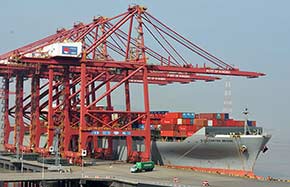
On the face of it trade activity looks healthy. The number of containers traversing the world's shipping lanes is rising steadily after a sharp shock during the financial crisis. Yet the value of the goods they contain is dropping as commodity prices struggle. Before the crisis trade was growing faster than GDP. Now it isn't, buffeted by a dangerous mix of economic and political headwinds.
Some are being tempted by the argument that trade is the primary cause of inequality, and that the system is run by global elites who work against national interests. This narrative is fundamentally wrong. It threatens global peace and prosperity by encouraging policy-makers to resort to protectionism at a time when the world urgently needs more trade liberalisation, not less, to tackle the great socio-economic issues of today and tomorrow.
All advocates of free and fair trade need to repel this false narrative and regain the initiative, which means doing three things.
The first is to explain that trade exists because people want it to. At its heart is the simple concept of comparative advantage, whereby a community that can produce goods others need is empowered to sell to those buyers and so afford to buy the goods it needs in return.
Maritime trade was how cutlers made my home city of Sheffield into the steel capital of the world, and how those same cutlers were able to buy imported goods such as tea, cotton and rubber. Digital trade is how we can now buy Hollywood blockbusters from video-on-demand platforms hosted on servers a continent away. Trade isn't just about physical goods, it's increasingly about services too, which are being made more tradable by technology.
Trade is essential for prosperity, stability and security. According to the OECD, manufacturing workers in countries that are relatively open to trade earn between three and nine times more than their peers in closed economies. Half a century ago South-East Asia was tearing itself apart, but this year the ASEAN bloc celebrates its 50th anniversary. Through cooperation and commerce the member states have collectively built the world's seventh-biggest economy, and by 2030 we expect ASEAN to rank third.
The second thing we need to do is to acknowledge that the benefits of trade haven't been shared evenly, so we must find policy solutions that rebuild trust by supporting wealth distribution and protecting the vulnerable. Rather than leaving responsibility for the displaced solely to governments, businesses must play a greater role in a world where technology and automation are already revolutionising how we live and work.
Paying tax isn't enough; companies need to collaborate with governments to develop education and labour markets that give workers the skills and protections they need to succeed.
The third thing is to ensure we have legal and regulatory frameworks that optimise access to trade. This means making procedures, standards and agreements simpler and more consistent so it's easier for companies to conduct cross-border business. It also means ensuring that capital regulation encourages trade finance by recognising its low risk profile, enabling financial institutions to fill more of the estimated $1.7 trillion gap in unmet demand for trade finance.
Trade is not a panacea for all the world's problems, but its power to create prosperity is enormous. This, fundamentally, is why I take a glass-half-full view of the future.
Some unstoppable trends are already in motion that will advance trade and increase prosperity in the twenty-first century. E-commerce is empowering businesses to sell to customers in countries without ever setting foot there. Over the next 30 years the expansion of the middle classes in Asia and Africa will lift some three billion people out of poverty.
Asia-led initiatives are building a more integrated global economy – such as the single market of the ASEAN Economic Community and China's Belt and Road Initiative, which has halved the time it takes for goods to travel between the UK and China by rail.
But only by repairing trust in trade, and by creating a better and fairer system, can we take advantage of these trends and seize the opportunities on offer. This is important work for the German G20 Presidency as it strives to defend the legitimacy of trade as an engine of human progress.
We have an opportunity today to create a new era for trade – where negative perceptions are dispelled, where gains are distributed more evenly, and where access is increased on an unprecedented scale. The result will be a better and brighter future for us all.
The author is Global Head of Trade and Receivables Finance, HSBC.