..
Tree-planting project cleans Yangtze's branches
Updated: 2016-04-08
By Luo Wangshu and Tan Yingzi, China Daily


Scientists have successfully developed a four-phase recovery program for river ecosystems that have been altered by the construction of the Three Gorges Dam, report Luo Wangshu in Kaixian county and Tan Yingzi in Chongqing.
Construction of the Three Gorges Dam, the world's largest hydroelectric project, has brought power to millions of residents and eased the passage of water traffic along the Yangtze River. The downside is that the dam has also affected the water levels and ecosystems of many of the river's main tributaries, resulting in pollution and damage to the environment.
Now, the banks of the Pengxi River, a tributary of the upper reaches of the Yangtze River, are steadily being planted with nonnative trees in an attempt to arrest the decline of the environment and reverse the process.
The waterway is located in Kaixian county in southwestern China's Chongqing municipality, an important section of the Three Gorges Reservoir. Trees have been planted, some above the waterline and some below, in what appears to be a random fashion, but is actually in accordance with a specific model designed to restore the ecosystem.
Depending on the season, the depth of the water in the areas around the Three Gorges Reservoir can fluctuate by as much as 30 meters. The level of the Pengxi River rose after the dam was completed in 2009, and now reaches its highest point, 175 meters above sea level, during winter, and its lowest ebb, 145 meters above sea level, in summer.
"The fluctuations in the water level have changed the environment," said Zeng Bo, a professor of ecology at Southwest University in Chongqing.
"Before the Three Gorges Dam Project, many of the plants along the riverbank were always above the waterline, but now they are submerged whenever the water rises," he said.
"The differing water levels have killed many plants. Native plants were suddenly unsuited to the new environment and many died, resulting in a number of environmental problems," he said.
Declining plant diversity
Those problems include a decline in the number and diversity of native plants and animals, soil erosion along the banks and dead plants that produce nitrous oxide, polluting both the water and the air.
Experts and policymakers have now initiated a raft of restoration projects, and their efforts have official backing at the highest level.
Speaking at a forum earlier this year, President Xi Jinping said the restoration of the Yangtze River ecosystem should be made "an overwhelming priority", and urged experts to "focus on extensive protection, and not engage in large-scale development".
Xi placed green development high on the government's agenda, and called on workers to "protect the environment like we protect our own eyes, and care for the environment in the same way we care for our own lives".
However, even before Xi's call to arms, local people had started work to restore the riverside environment.
"The total fluctuation area of the Three Gorges Reservoir is 348.93 square kilometers, distributed across 22 counties and districts in Chongqing and four counties in Hubei. Nearly 46 percent of the fluctuation area is along the main stream of the Yangtze River and 54.1 percent runs along the tributaries," said Luo Ren, former president of the Chongqing Forestry Society.
"As the county with the largest and most-concentrated fluctuation area in the region of the Three Gorges Reservoir, the fluctuation area in Kaixian is 42.78 square kilometers," he said, adding that the gently sloping contours of the fluctuation area provide perfect conditions for experiments to restore the ecosystem.
"The key is to find water-tolerant trees that can survive in the new environment to help prevent soil erosion and restore the local ecosystem," he said.
Four-phase model
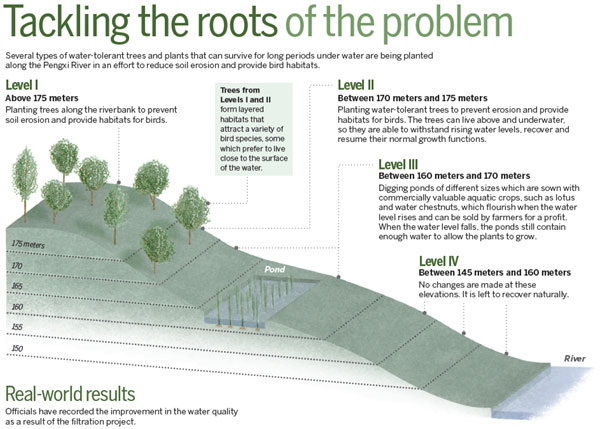
Kaixian has adopted a new four-phase model, which is implemented according to the prevailing water level.
"At Level I, when the water level is higher than 175 meters, we plant trees such as cypress, cedar, bamboo, water birch and willow along the riverbanks to prevent soil erosion, intercept pollutants and provide habitats for birds," said Xiong Sen, head of the Pengxi River wetland natural reserve administration bureau in Kaixian.
At Level II, when the level is between 170 meters and 175 meters, water-tolerant trees, such as pond cypress and Chinese swamp cypress, are also planted to combat soil erosion and provide habitats for birds. The plants can live both above and below the waterline, so they can withstand the changes in water level, recover and then resume their normal growth functions.
Trees at Levels I and II form layered habitats that attract a wide range of bird species, many of which prefer to live close to the surface of the water.
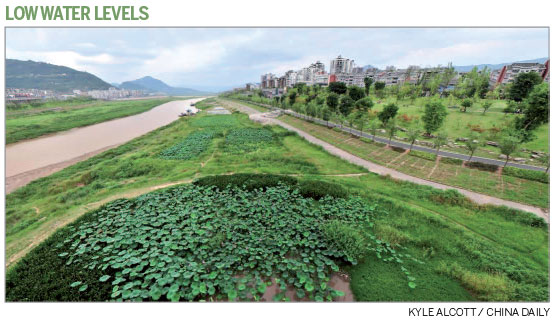
"At Level III (between 160 meters and 170 meters), we dig ponds of different sizes and depths. They are sown with commercially viable aquatic crops, such as lotus and water chestnuts, which flourish when the water level rises and can be sold by farmers for a profit. When the water level falls, the ponds still contain enough water to allow the plants to thrive," he said.
At Level IV (between 145 meters and 160 meters) restoration of the eco-system is reliant on natural recovery.
The four-stage filtration process has resulted in much cleaner water, according to the local environmental protection bureau, which has conducted annual tests since 2010 and began analyzing the results in 2013.
Although it was not an instant success, the model has gradually borne fruit.
"The diversity of bird species (in the area around Kaixian) rose to about 200 last year, from 130 in 2010," said Huang Yazhou, the administration bureau's deputy head, who attributed the development to the improved environment.
Huang, a passionate birdwatcher, has witnessed the rising numbers and greater diversity of birds in the county.
"The change in the status of birds in the area reflects the improvement in the local ecosystem," he said. For Huang, the improved conditions were signaled by the discovery of three Chinese mergansers, an endangered species of duck, in Kaixian.
"In February 2014, I regularly observed the birds along with another birdwatcher. One day, we saw some new birds, which looked like mergansers. If they had been ordinary mergansers, it would not have been a big deal, but the birds we saw looked slightly different.
"We found a boat, rowed closer to the birds and took some photos that confirmed that they were Chinese mergansers. I was so excited. It was a first for me. When we were sure the birds were indeed Chinese mergansers, we did everything we could to take more photos. We contacted many people, including cruise companies and television stations. The bird-watching community in Chongqing was thrilled," he said.
Huang was excited as he recalled the experience, which underlined the improvements in the local environment, especially the river from which the birds got most of their food.
In the summer of the same year, Huang also saw a spot-billed duck chick in Kaixian. "The spot-billed duck belongs to the Anatidae family of migratory birds, which usually spend the winter in the south of China, including Chongqing, before flying north in summer - to the Changbai Mountains in Jilin province, or to Siberia, for example - to nurture their chicks," he said.

"The chick was about 20 days old, which meant it had definitely been born in the area. It was the first recorded instance of Anatidae migratory birds (which include ducks, swans and geese) breeding in Chongqing. That was good news for us, because the birds will only breed in a clean, natural environment," he said.
Birds of prey, such as Bonelli's eagle, have also been seen in the area. "The presence of raptors indicates that the food chain for predators has improved," Huang said.
Trial and error
The new model came about as a result of trial and error. In 2010, Luo and his team at the Chongqing Forestry Academy introduced foreign plant species, including river birch and water tupelo, which are common in Tennessee and Maryland in the United States, to the county.
The trial was only partially successful, however, as most of the trees survived the first two years of the experiment, but a number died.
Constant experimentation has resulted in the bureau experiencing its fair share of failure. "For our experiments in the past five years, we selected about 20 species at first, including poplars and water birch. But only six species survived," said Xiong from the administration bureau.
Luo said the improvements in the local ecosystem are heartening, but the process is far from complete: "Not all parts of the fluctuation area can be restored by science and technology. Most of the changes are dependent on natural recovery, which will take time."
Contact the writer at luowangshu@chinadaily.com.cn

|
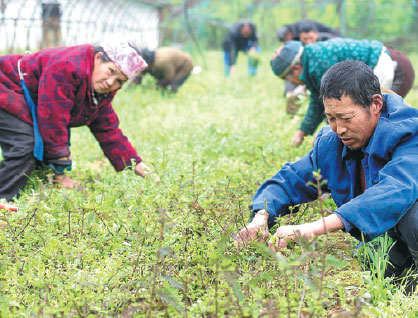
Workers care for saplings that will be planted along major tributaries of the Yangtze River in Chongqing. Liu Chan / Xinhua |

(China Daily 04/08/2016 page6)

Video

UK trade commissioner for China praised Chongqing as a burgeoning center in intelligent manufacturing.

