..
Young entrepreneur's rocket dream takes off from Chongqing
Updated: 2018-08-13
By Zhao Lei, China Daily


OneSpace founder Shu Chang has been compared to Elon Musk
 |
|
OneSpace Technology CEO Shu Chang (right) works at the private rocket company's exhibition room in Beijing. China Daily |
OneSpace Technology CEO Shu Chang's 4-year-old daughter often tells her kindergarten classmates that her father "makes giant rockets".
The entrepreneur and his wife have repeatedly told their daughter not to "show off", but she has good reason to be proud. Shu founded China's best-known private rocket maker three years ago and is often compared to Elon Musk, the founder of SpaceX in the United States.
Shu, 32, led the employees at OneSpace - the first private enterprise in China licensed to design and make carrier rockets - in the successful production of a small rocket launched in mid-May. The success generated a wave of media reports about Shu and his company, with many articles calling the Beijing startup China's answer to SpaceX.
Shu was born in December 1985 to a family of businesspeople in Yueyang, Hunan province. During his childhood and adolescence in the prosperous city, Shu knew little about space exploration and rockets. Instead, he dreamed of starting his own business. "I was a leader in my class at middle school, and my scores were fairly good," he said. "My teachers told me that they expected me to become a leader in whichever career I chose."
However, he was not sure what industry to choose for his business. At the age of 18, Shu was admitted to Beijing's Beihang University, which specializes in aeronautics and astronautics, majoring in aircraft design - a field he chose because it seemed a "cool" specialty.
However, he did not join an aircraft design institute after receiving his bachelor's degree in 2008; instead, he joined a Beijing startup that was trading aviation materials. Shu said he felt he "needed to amass some experience in doing business at a startup".
But he did not spend long in that first job, as he found he still "lacked a lot of things" he needed before "becoming qualified to start a business". He quit the job and applied for a two-year postgraduate program at Peking University's Guanghua School of Management, one of the top business institutes in China.
In his final days at Guanghua, Shu was given several offers from well-paying private equity firms, but he decided to join an investment foundation of China Aerospace Science and Technology Corp, the biggest State-owned space contractor. He worked there from 2011 to 2013, first as an investment analyst and then an investment manager.
Having learned about corporate financing and investment analysis at the foundation, Shu took the last step before starting his own enterprise - joining Legend Holdings to learn business strategy and corporate management.
At Legend, Shu was quickly promoted from an investment manager to a vice-president of investment due to his impressive performance, said He Wen, a colleague at Legend who is now a founding partner at Chunxiao Capital.
In early June 2015, a few days before Legend's initial public offering in Hong Kong, Shu resigned, even though several executives tried to dissuade him from abandoning a promising career.
"One reason was that I kept telling myself that I must start my business before 30," Shu said. He added that another catalyst was his realization that space-launch services would become a lucrative industry, one with abundant opportunities for private Chinese firms.
"I thought that I must move quickly otherwise these precious opportunities would be seized by others and they would gain the initiative," he said.
Since the first day of China's space industry, the research and development of the nation's carrier rockets has been dominated by government-backed giants such as China Aerospace Science and Technology, which has been responsible for manned missions and lunar exploration.
However, the government has gradually realized that new players need to be introduced to stimulate innovation and competition, and to fill in market gaps left by established contractors.
President Xi Jinping has asked the nation's long-insulated space industry to open its doors to private participants and take advantage of their participation to boost sustainable growth.
Meanwhile, several government departments have published policies and guidelines that encourage private enterprises to take part in space-related businesses.
As a result, about 10 private rocket firms have been founded in China in the past three years. Three of them - One-Space, i-Space and LandSpace, all based in Beijing - have become leaders when it comes to research and production capabilities and funding.
Shu started finding partners for his enterprise in 2014, as the thought of creating China's first private rocket maker gradually formed. He reached out to a lot of rocket researchers at the China Academy of Launch Vehicle Technology, the country's largest rocket developer. However, most replied with polite refusals.
Finding the right partners was "more difficult than finding a good wife", he said, adding that it took a lot of persuasion to lure seven people, including one engineer from a State-owned space company, to join his team.
Two of the seven have since quit because of differences over the company's development path, Shu said.
From OneSpace's founding in mid-2015 until the end of 2016, Shu said he and his colleagues were focused on market research and analysis, determining what kind of rocket the startup should develop, and contacting equipment suppliers.
OneSpace formally commenced its research on solid-propellant rockets and engines last year, with the goal of staging its first launch this year.
In late December, the company conducted a successful ignition test on its first rocket engine at a testing facility in Jiangxi province.
On May 17, an OS-X suborbital rocket, the pioneer in Shu's prospective rocket family, blasted off from a testing base in northwestern China. The event was widely covered by domestic and foreign media as a milestone in China's space sector.
"There had been a great deal of difficulties and suspicions before we made it, and some of them still exist now," Shu said. "But I've been convinced for a long time that it's a must for China to open its space sector to private players, and that private enterprises like ours will find our niches. We must persist with our aspirations and efforts despite difficulties and obstacles."
He said many officials in China's space authorities and State-owned space companies are supportive of OneSpace's endeavors and have encouraged him to continue pursuing his goals.
After the launch in May, some space engineers working for State-owned companies applied for jobs at OneSpace. New clients willing to entrust their satellites to his company also swarmed in, Shu said.
"Now I have more than 160 employees, 40 of them recruited after our May launch," he said. "All of us at OneSpace were inspired by the success and now have more confidence in our abilities and technology."
Shu said he does not fear rivals in the industry and hopes that more private companies join the field.
"The more players involved in this sphere, the better and healthier the market is likely to become," he said. "I look forward to seeing more participation from private firms."
The only advice he would give to peers is that "they carefully consider their development paths and profitability".
However, he said only two or three private Chinese rocket enterprises will survive the next five years of fierce competition in the market, and he is sure OneSpace will be among them.
"Of course, OneSpace will not fall down, because we have a united team, advanced technologies and good products," he said. "We will definitely thrive in this field in the coming 20 years."
zhaolei@chinadaily.com.cn

Video
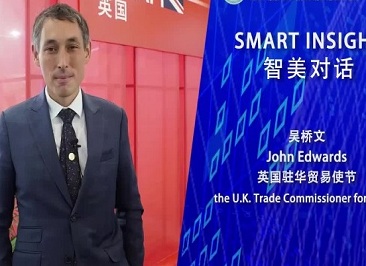
UK trade commissioner for China praised Chongqing as a burgeoning center in intelligent manufacturing.

