Comments
  Print
Print  Mail
Mail  Large Medium Small
Skiing in China is growing in popularity, but Olympic glory is still a long way off
When Xing Zhiliang, an IT company employee in Beijing, took his son Xing Haoyu to Wanlongbayi Ski Resort in Beijing's western suburbs last Saturday evening, the crowded scenes were beyond his imagination.
"It was my first time skiing in the evening session and I thought it would be less crowded than the daytime, but obviously I was wrong," said the 38-year-old, who started to ski in 2006.
|
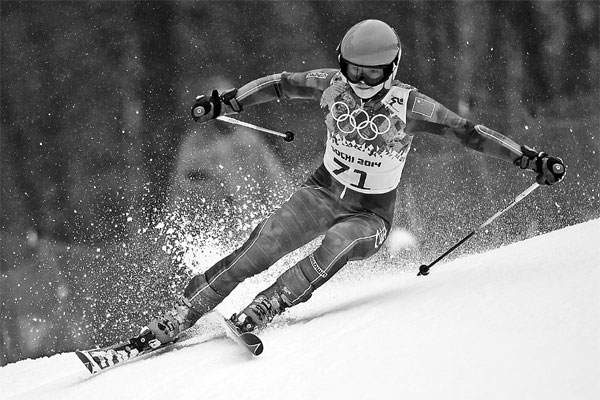
China's Xia Lina competes during the women's alpine skiing giant slalom race at the Sochi Winter Olympics on Tuesday. Xia finished second last, only 11.35 seconds ahead of violin virtuoso Vanessa Mae, representing Thailand, among the 67 participants who completed the event. Olivier Morin / Agence France-Presse |
Arriving at the resort at about 6:00 p.m., Xing and his son spent almost 90 minutes waiting in a long line to rent skiing equipment at the crowded reception hall.
"I specifically came late today because I heard it would be less busy at night when people all go back downtown for dinner. But it seemed as crowded as daytime here," said Xing.
It has become a common scene at Beijing ski resorts as more and more skiing fans venture onto the snow.
However, the sport's growing popularity was not reflected on the slopes of the Sochi Winter Olympic Games.
Experts claim a short history of development and a lack of world-class ski venues mean China still has a long way to go before it can become a winter sports powerhouse - especially on snow.
"Many Chinese people started to take up skiing after the 1996 Asian Winter Games, which was held in Harbin, northeast China's Heilong-jiang province. Before that, only professional athletes did the sport," said Gao Xuedong, deputy secretary-general of the Chinese Ski Association.
"It has only been developing for fewer than 20 years and for most of the basic winter sports, such as alpine skiing and ski jumping, we don't have training venues right now. Therefore, snow events are developing very slowly in China," said Gao, who is in charge of promoting skiing among the public as well as developing snow events in China, such as alpine skiing.
According to Gao, there are about 300 ski resorts across the country, but most are not world-class in terms of the height between the foot and top of a mountain.
"The height of the mountains at about 85 percent of the ski resorts in China is below 200 meters, while about another 10 percent are between 200-300 meters," Gao said. "According to International Ski Federation standards, the height of a mountain for official downhill events should be at least 800m. We have no training venue like that, so we cannot expect world-class competitors any time soon."
At the Sochi Games, 69 gold medals were on offer in snow events out of a total of 98 gold in 15 sports.
China sent athletes to compete in five snow sports in Sochi - biathlon, alpine skiing, cross-country skiing, freestyle skiing and snowboarding. But, except for freestyle aerials, in which China won silver and bronze, most of the other events saw the Chinese athletes struggle to reach even the top 40.

"Alpine skiing, biathlon and ski jumping are the most popular snow sports in western countries," said Gao.
"But the Chinese athletes are at a very low level as they are young and don't have many opportunities to train and compete at advanced venues.
"With our current ski venues, we can only compete in some technical events, like slalom and giant slalom. As for the speed events, such as super-G and downhill, we cannot even attempt them as we have no suitable venues for quality training."
However, Gao said the ski industry has developed greatly in China in recent years and the capital is at the center of it.
"There are roughly 500,000 to 800,000 people skiing in China each year and the market in Beijing is the biggest," Gao said.
According to beijingski.com, there are 12 well-equipped ski resorts around Beijing, providing services at an average price of 150 yuan ($25) including tickets, equipment rental and facility fees for a whole day.
And, with prices going down, skiing has become the new craze for youngsters who want to be active and socialize in winter.
Since it was established in 2010, the Beijing College Skiing Union has organized about 70 group tours which have attracted more than 4,700 students.
Bidding is a booster
Bai Jiayu, an amateur snowboarder from the China University of Geosciences, said the level of skiing and snowboarding has improved a lot in recent years, thanks to the growing number of affordable resorts.
"More and more new resorts have opened around the city to make the competition even fiercer for customers so the costs have been reduced significantly," said Bai.
The bid by Beijing and neighboring city Zhangjiakou for the 2022 Winter Olympics is expected to trigger even greater enthusiasm for winter sports in China.
According to the bid plan, temporary venues will be built for sports such as bobsleigh, luge, skeleton and alpine skiing in the Xiaohaituo Mountain area of Yanqing County, which is about 90 kilometers northwest of Beijing. Other ski sports will be held in Chongli County of Zhangjiakou, which is about 220 km from Beijing and 130 km from Xiaohaituo Mountain.
Nick Ward, an amateur snowboarder from New Hampshire, a northeastern state in the US, said the rise in interest in winter sports here was logical.
"There is a lot of interest in skiing back in my hometown but I can tell the Chinese people are interested and like it and I can see it growing in popularity," said Ward, who was also at Wanglongbayi on Saturday night.
"The facilities (in Beijing) are all right, nothing to write home about, but they are adequate.
"(If Beijing could successfully win the Olympic bid), of course all the added exposure can't but help increase interest in winter sports among the Chinese."
Gao agrees.
"The bidding for the 2022 Winter Olympics will offer a golden chance for Chinese winter sports to develop, especially the snow events," Gao said.
"The Xiaohaituo Mountain in Yanqing County meets the standards of an Olympic venue in terms of the height of the mountain. The building of high-standard skiing venues there will offer an Olympic-standard training venue for our skiers.
"There are still eight years to go before the 2022 Games. I think we will get our best results in snow events then - if we win the right to host the Games."
Contact the writers at sunxiaochen@chinadaily.com.cn and leilei@chinadaily.com.cn
(China Daily 02/22/2014 page15)

 China lands 2 silver, 1 bronze on short track
 New uniforms for 2014 CSL teams unveiled
 LeBron James leads Heat to big win over Thurder
 Formula One testing in Bahrain
 Russian stuns Kim to win dramatic figure skating gold
 Russia's snowboard couple medals together in Sochi
 Kids race on course to future success
 Canada beats China 10-6 in men's curling semis
Copyright 1995 - . All rights reserved. The content (including but not limited to text, photo, multimedia information, etc) published in this site belongs to China Daily Information Co (CDIC). Without written authorization from CDIC, such content shall not be republished or used in any form. Note: Browsers with 1024*768 or higher resolution are suggested for this site.
License for publishing multimedia online 0108263 Registration Number: 20100000002731