WHO decries increasing cholera cases in Somalia
Updated: 2011-08-19 10:59
(Xinhua)
|
|||||||||||


|
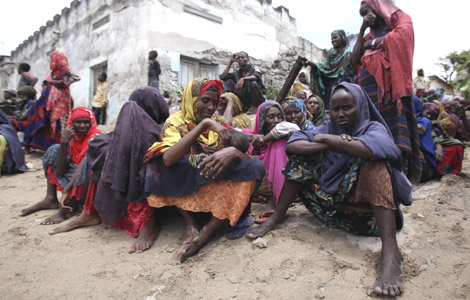
 Internally displaced people wait to collect food aid at a distribution centre at Badbaado settlement camp in Somalia's capital Mogadishu August 18, 2011. [Photo/Agencies] |
NAIROBI - The World Health Organization (WHO) on Thursday decried increased number of confirmed cholera cases in the Somalian capital Mogadishu, and growing reports of acute watery diarrhea in Kismayo and other crowded urban centers, saying an urgent multi-sector response to contain the spread of this highly contagious disease is being mounted.
The UN health agency said has confirmed cholera in Banadir, Bay, Mudug and Lower Shabelle regions and the number of acute watery diarrhea cases has increased dramatically in the last few months.
 |
"For the last few years, a network of health workers reporting to the early warning system is in place, however they report through a health facility or mobile clinic. Yet the large numbers of displaced people in Mogadishu are making it more difficult to record the various diseases," Everard said in a statement issued in Nairobi.
"We urgently need more mobile clinics that will provide basic health care services to the many displaced and who will strengthen the reporting on new outbreaks. This is critical to our response and our ability to save lives."
According to WHO, about seventy-five percent of all cases of acute watery diarrhea are children under the age of five.
Since January this year, 4,272 cases of acute watery diarrhea/ cholera have been reported in Banadir Hospital in Mogadishu alone. However, at this stage most of the cholera cases in the various regions are contained and under control.
"Our major concern is to monitor and detect new disease outbreaks in the many informal settlements set up by internally displaced people in and around Mogadishu", says Everard.
Although cholera is endemic in the country, the last major cholera outbreak was in 2007 with an estimated 67,000 cases.
WHO said recent efforts to cholrinate the water supply of Mogadishu, along with efforts to improve hygiene and sanitation have prevented a serious outbreak but with the large influx of some 100,000 people alone this year into Mogadishu, bringing the total number of IDPs in the capital to an estimated 470,000, many are living in overcrowded settlements, there is an acute shortage of safe water and adequate sanitation.
"There is no need for a child to die of diarrhea, yet this is tragic reality for a Somali child, who is acutely malnourished. It is a lethal combination." said Rozanne Chorlton, UNICEF Representative for Somalia.
"These types of diseases can be prevented and treated quickly, but to save children's lives we need to make sure safe water, sanitation and hygiene along with early access to primary health care, are an integral part of our emergency response."
WHO said partners in the health and water and sanitation sectors are currently preparing for a potential 100,000 cholera cases including 80,000 moderate cases and 20,000 severe cases.
Emergency diarrheal disease kits made up of medical supplies such as syringes, infusions, and oral rehydration fluids (ORS), already prepositioned by UNICEF and WHO have been sent to 13 hospitals.
An additional 200 diarrheal disease kits, each able to treat 100 severe cases and 400 moderate cases are being procured and should be in Southern Somalia in the next few weeks, it said.
In addition, WHO said, the case management of severe dehydration with and without malnutrition is being strengthened and focus is now on mobilizing a network of already trained community health promoters to move from door to door with health hygiene education messages.
"Health posts will be stocked with essential medicines and ORS to identify and promptly treat patients. Many of Southern Somalia' s rural areas and urban centers rely on shallow wells, which unless protected or treated with chlorine can serve as the perfect breeding ground for water borne diseases," it said.
To respond to this threat and prevent a major outbreak, the UN health agency said partners in the water, sanitation and hygiene sector are scaling up their actions to target 1.5 million people across high risk areas of the south.
Supplies of chlorine and essential items for hygiene and household treatment and storage of water are being distributed.
Already 217 water sources are being chlorinated and 58 water point outlets benefitting 483,200 residents and internally displaced people in Mogadishu.
In addition, household hygiene supplies, including water purification tablets, soap and buckets, enough for 48,000 families, are being distributed at existing feeding centers for malnourished children.
Campaigns to educate families about the treatment of drinking water, safe disposal of waste and encourage hand washing with soap will also be scaled up in high risk communities.
As part of the updated 2011 UN Consolidated Appeal for Somalia, an estimated $80 million is needed for the health sector and 78 million dollars is required for the water, sanitation and hygiene sector.
So far, each sector has respectively raised 30 percent and 37 percent of the required money.



Hot Topics
The European Central Bank (ECB) held a conference call late on Sunday ahead of the market opening, pledging the ECB will step in to buy eurozone bonds with efforts to forestall the euro zone's debt crisis from spreading.
Editor's Picks

|

|
|

|

|

|