Crazy Horse sculptor's widow carries on mountain dream
Updated: 2011-09-06 10:18
(Agencies)
|
|||||||||||


CUSTER, S.D. - Nearly every morning for more than half a century, 85-year-old Ruth Ziolkowski has risen around dawn, put her feet on the ground and given thanks she is part of a dream.
 |
|
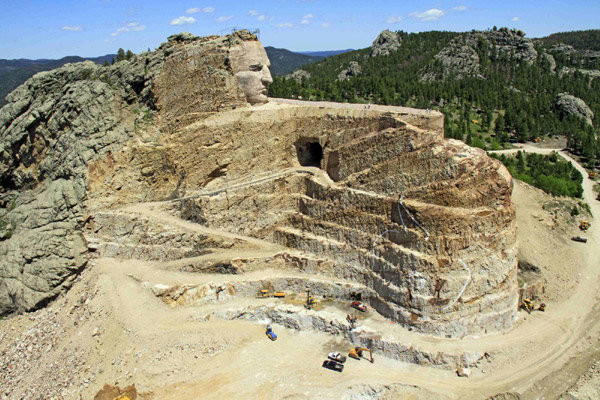
The Crazy Horse Memorial mountain carving in the Black Hills of South Dakota is the world's largest sculptural undertaking as seen in this recent photograph released to Reuters on September 5, 2011.[Photo/Agencies] |
Since 1947, she has worked at the Crazy Horse monument to Native Americans in the Black Hills of South Dakota, where she is leading the effort to literally move a mountain.
"I'm tickled to death to get up every morning and go to work," Ziolkowski, president of the non-profit Crazy Horse Memorial Foundation, said in an interview this summer.
Billed as the world's largest sculpture, Crazy Horse is only a 20-mile (32-km) drive from better-known Mount Rushmore, where faces of Presidents George Washington, Abraham Lincoln, Thomas Jefferson and Theodore Roosevelt are carved into granite.
A few more miles down the road is Pine Ridge reservation, a mostly barren land where more than half the residents live below the poverty line, according to government figures.
Pine Ridge is where many Sioux Indians of Crazy Horse's Oglala tribe were put after they were pursued by the US Army, starved of the buffalo they hunted, and had their traditional lands confiscated.
Rival to rushmore
 |
|
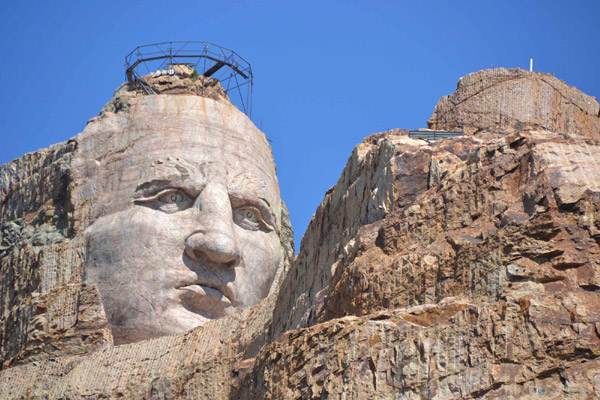
The nearly 90-foot-tall carved granite face of Crazy Horse is seen in South Dakota's Black Hills in this recent photograph released to Reuters on September 5, 2011.[Photo/Agencies] |
Unhappy that a monument to white leaders was carved into mountains the Sioux considered sacred, Lakota Sioux elder Chief Henry Standing Bear invited to Pine Ridge Korczak Ziolkowski, who in 1939 had won the New York World's Fair sculpture prize.
They decided to carve a rival monument to Native Americans featuring Crazy Horse, a Sioux warrior who helped lead one of the most famous Indian victories over the U.S. Army -- annihilating much of General George Armstrong Custer's Seventh Cavalry at the Battle of Little Bighorn in 1876.
Ziolkowski began working on the granite mountain along with volunteers including young Ruth Ross from Connecticut. Ruth and Korczak were married in 1950, and raised 10 children at the foot of Crazy Horse.
"He felt we had done them (the Indians) a terrible wrong and he wanted to right some of that wrong," she said.
Many people thought Korczak's plan was indeed crazy.
Mount Rushmore took 14 years to complete, cost $1 million at the time of which 85 percent was government money, and used around 400 workers, according to the National Park Service.
Stubbornly independent, Korczak accepted only private donations. He sketched out a monument much larger than Mount Rushmore, with the warrior on horseback and hand outstretched.
All four of Mount Rushmore's presidential heads would fit inside just the warrior's head at Crazy Horse, said Pat Dobbs, spokesman for the monument. Korczak also wanted to carve completely around the mountain, while the presidents' faces are only on one side of Mount Rushmore.
Native American opposition
Some Native Americans opposed the project. They said Henry Standing Bear had no authority to invite a white man to carve the monument, and said it was desecrating the Black Hills and exploiting an Indian hero. They said Crazy Horse, described in history books as a quiet man, would not have approved.
Indian activist Russell Means said the Crazy Horse carving was like going to the Holy Land of Israel and carving on Mount Zion. "It is an insult to our entire being." he said in 2001.
Korczak worked virtually alone on the mountain for years and died in 1982, 16 years before the first part of the carving -- the giant face of Crazy Horse -- was completed in 1998.
To this day, the horse and outstretched hand of Crazy Horse are only in rough shape. Plans are to complete the horse's head next, although Ruth was careful not to give a completion date.
Whether the unfinished Crazy Horse is a monument to sheer persistence or utter futility, the project has expanded, with a visitors' center including a museum, restaurant and gift shop, and numerous events. A fundraising drive begun in 2006 netted $19.3 million by the end of 2010, including in-kind donations.
About a million people trek to Crazy Horse every year, and the entry fees account for 40 percent of revenues with most of the rest from private giving, Dobbs said. On some days, tourists can view a dynamite explosion as mountain blasting continues.
Emphasis on education
But the most important change has been an emphasis on Native American education. Ruth said her husband always dreamed an Indian University of North America would be on the site.
A dormitory has been built, and beginning in the summer of 2010, Crazy Horse provided a program for students, some of them Native American, to work at the tourist center and take classes such as math and writing in preparation for college.
One of those students, Dylan Tymes, who grew up on the Pine Ridge reservation, said he is hoping to start his second year of college soon. Tymes said Pine Ridge was a rough place, a "ghetto," with few jobs and many people living on food stamps.
Tymes said even some of his own family were skeptical of the Crazy Horse memorial, but the education project and summer job won him over. "If it wasn't for the Crazy Horse program, I don't think I would even be in college right now," he said.
Some prominent Native Americans also are joining with the Ziolkowski family to help. Five of the 26 foundation board of directors are of Native American heritage.
Billy Mills, a project adviser and Lakota Sioux, who in 1964 became the only American ever to win the Olympic 10,000- metre run, said the warrior Crazy Horse was one of his boyhood idols. After Mills' mother died when he was a young boy, his father spoke of Crazy Horse to calm his son's anger and lift him from the self-pity that Mills said destroys many Indians.
Mills does not believe Crazy Horse would be angry about the mountain carving if he were alive but would "use it as an opportunity to teach the world about indigenous people."
Ruth Ziolkowski is fine with the fact that she will not see Crazy Horse finished in her lifetime. But to her nine living children, two of whom are on the foundation board and a third a foreman on the mountain directing work, she has a clear wish.
"If this project stops because I die, my life has been wasted," she said.




Hot Topics
Libya conflict, Gaddafi, Oil spill, Palace Museum scandal, Inflation, Japan's new PM, Trapped miners, Mooncake tax, Weekly photos, Hurricane Irene
Editor's Picks

|
|

|

|

|

|