China sheds light on alleviating poverty in India









 |
| SHI YU/CHINA DAILY |
"A good life is created with one's own hands, so poverty is nothing to fear. If we have determination and confidence, we can overcome any difficulty," President Xi Jinping said on June 16, 2015.
During the 11th ASEAN-China Forum on social development and poverty reduction, held in northwest Cambodia's Siem Reap province for two days from July 26, Nick Beresford, United Nations Development Program (UNDP)-Cambodia country director, praised China for its great success in reducing poverty, lifting hundreds of millions of its people out of poverty. He said China's best practices and successful experiences in poverty reduction should be a "role model" for ASEAN countries.
Beresford added China, the most populous country in the world, made an active contribution to the world's poverty reduction. The nation is the largest contributor to the UN's Millennium Development Goal of halving the number of people in poverty worldwide, and the success was delivered by a combination of strong leadership, comprehensive policies, targeted measures, increased investment and an incentive mechanism, providing inspirations for global poverty alleviation governance.
Since the reform and opening up policy in the late 1970s, the Chinese government has to alleviate poverty through development. After 37 years of effort, about 700 million people have been lifted out of poverty in China. Poverty reduction of this magnitude is unparalleled in human history, and never before have so many people been lifted out of poverty over such a brief period of time. The achievement has also been recognized by the United Nations.
The Chinese government launched a package of targeted poverty reduction programs covering areas including physical infrastructure, social development, industrial development and income generation. It also covers assisting disadvantaged households and areas, and improved their ability to share the benefits of national growth and generate more income by themselves.
The United Nations Development Program (UNDP) calculated China had contributed 76 percent of all global poverty reduction to date. The nation has been playing a role in the implementation of the Sustainable Development Goals (SDGs), which benefits the international community by promoting its model and methods through knowledge sharing.
Ana Revenga, senior director of the Poverty and Equity Global Practice at the World Bank, praised China's poverty relief efforts and said "if anyone could show the world how to do the last mile of ending extreme poverty, it was probably China."
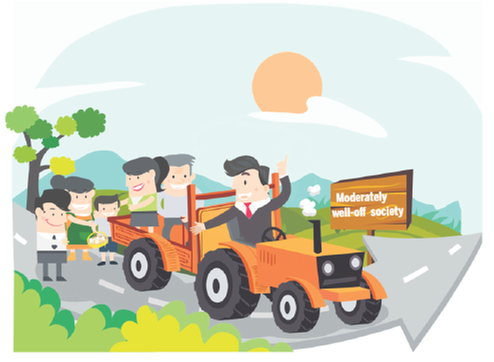
According to the 13th Five-Year Plan (2016-2020), China, under the leadership of President Xi Jinping, aims to eliminate poverty to become a "moderately prosperous society by 2020". To meet this goal, the Chinese government has vowed to lift 10 million people out of poverty each year from 2016 to 2020, 10 years ahead of the newly agreed UN Sustainable Development Goal poverty eradication target, through support for industry, education, employment and medical care.
The number of disadvantaged people in rural areas across China fell to 43.35 million by the end of 2016. President Xi Jinping said, while attending the annual session of the National People's Congress in Beijing on March 8, "it was the Party's solemn pledge to help all of the impoverished rural population out of poverty under the current standard and delist all poor counties by 2020." Certainly, setting a deadline for eradicating poverty is an extremely tough task; but there is no doubt China will again be the frontrunner in reaching the UN's post-2015 Development Agenda.
On the other hand, despite India's Five-Year Plan in developing economy, mechanical advance, commercial growth and scientific development, the demon of poverty has spread its tentacles all around the urban and rural areas. China is beating India in terms of poverty reduction and improvement in social indicators, such as life expectancy, health, per capita income level, education and infant mortality.
According to the World Bank's poverty line norm, India has the highest number of people living below the poverty line, with 30 per cent of its population under the $1.90 a day poverty measure. It's estimated millions of children in India live as modern-day slaves, and the grinding poverty forces parents and guardians to sell children into slavery. According to a study of the Oxford Poverty and Human Development Initiative, at least half of India's under-18 population lives in acute poverty.
Thousands of families in India do not find enough to feed themselves and, in a moment of complete dejection, they commit suicides, often collectively. There are millions of people who sleep with empty stomachs most of the times. There's a life-and-death struggle on the railroad tracks as there are many people who live dangerously near railway tracks and often risk their lives and don't have sources to feed their families. They also want good food to eat, good clothes to wear, good place to live in, but they are helpless as they don't have any kind of support. This is the dark side of poverty.
It is a pity that after 70 years of India's independence, India lags far behind China in battling poverty and in advancing living standards such as health, education and other social conditions. A total of 48 percent of Indians don't even have access to toilets. Around 65% of rural households have no sanitation facility. A third of the population in India does not have any electricity connection. It's a fact that access to drinking water and electricity within homes continues to be a distant dream for millions of Indians.
Rural poverty is further compounded by India's enormous health burden; India accounts for more than one quarter of the world's TB cases and deaths. In India, most villages don't possess even a small hospital. Unfortunately, in India's noisy political democracy, politicians are not too interested in alleviating poverty.
Since Independence, year after year, India's anti-poverty programmes are getting bigger without getting better. The blunt truth is that India's poverty alleviation programmes such as Mahatma Gandhi National Rural Employment Guarantee Scheme (MGNREGS), the Pardhan Mantri Gramodaya Yojana (PMGY), Antyodaya Anna Yojana (AAY), Pradhan Mantri Awas Yojana (PMAY), Pradhan Mantri Kaushal Vikas Yojana and other welfare schemes fail to reach the downtrodden. The outcomes in each programme are poor.
India's various welfare schemes will get a tremendous boost if it can learn lessons from China's experiences and achievements in poverty alleviation through the Southwest Poverty Reduction Project, the Poor Rural Communities Development Project, the Guangxi Rural Poverty Alleviation Pilot Project, the Qinba Mountains Poverty Reduction Project, the Gansu and Inner Mongolia Poverty Reduction Project, to mention a few.
Poverty is a huge stone on the path of India's development. It should be rooted out and the problem should not be tackled slowly. Poor Indians need money to fulfill their basic needs, not charity. The poor Indians deserve better than mere lip service or an entry in the government budget. Mother India would win then and only then if Indian political leaders make every effort to quickly eradicate poverty from the country, bringing prosperity into the lives of poor people through a sound political vision.
China is undoubtedly a world-leader in poverty reduction and improving health outcomes and there is a lot the rest of the world can learn from its experience. China is also willing to exchange and cooperation with India in the realm of poverty reduction. China's formula for reducing poverty could help India to accelerate its poverty alleviation programmes. Can India learn lessons from China's invaluable poverty reduction policies and rapid growth?
Rabi Sankar Bosu is the Secretary of New Horizon Radio Listeners' Club in West Bengal, India.