Off to a greener future, intelligence at the wheels










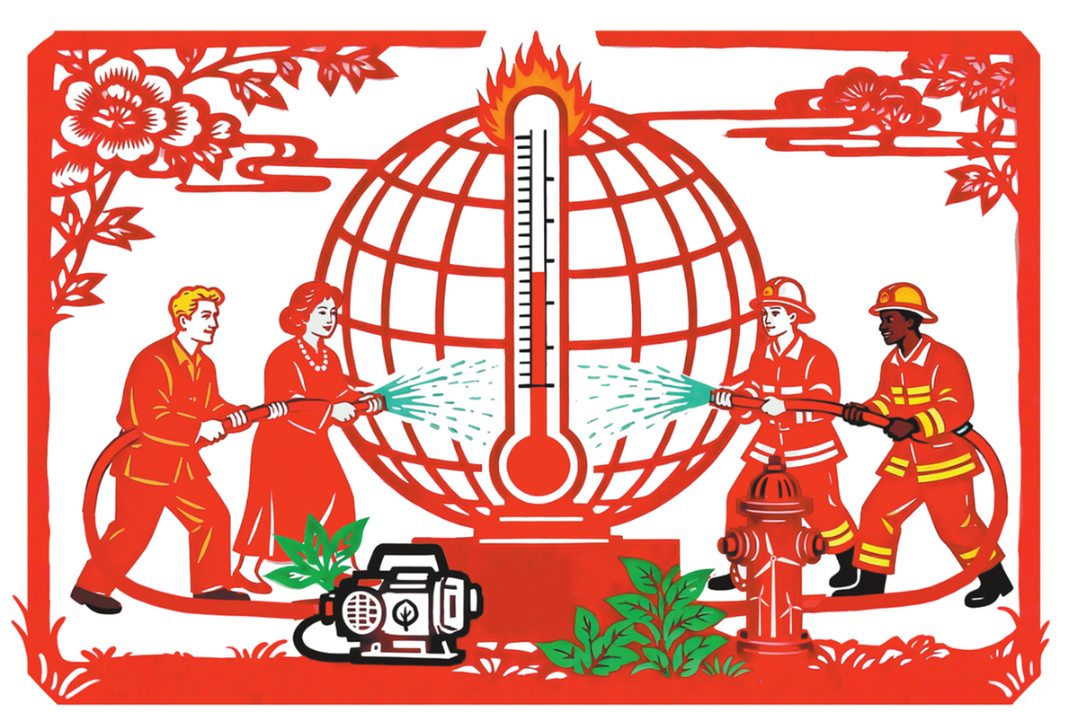
When people talk about the engines of tomorrow's economy, the conversation quickly turns to artificial intelligence — and rightly so. AI is the accelerator of a new kind of productive power: what China calls "new quality productive forces". But an engine needs a chassis and a fuel system. If AI is the engine, then computing infrastructure is the chassis — and how that chassis is powered will determine whether this new productivity is sustainable. That is why China's push to deepen "computing-power coordination" matters: it is about making the power base of new quality productive forces green, flexible and nationally integrated.
During a visit to Qinghai province in September, Premier Li Qiang highlighted Qinghai's significance in ecological protection, and its advantages in developing clean energy and green computing, calling for the steadfast pursuit of green development and the further integrated development of green computing and power. This is not merely regional boosterism. It is an explicit alignment of industrial policy with China's dual carbon goals of peaking carbon dioxide emissions before 2030 and achieving carbon neutrality before 2060, and with the leadership's insistence that the new quality productive forces themselves be green.
Viewing AI as the engine but neglecting how it is powered risks recreating the carbon patterns of the past. New quality productive forces are inherently green; the transition to them must itself be low-carbon. That means data centers and other computing facilities cannot be "internal-combustion" power bases masquerading as modern infrastructure. They must be electric — and powered predominantly by renewable energy. Only then will the "intelligent economy" be a green economy.
China's approach to building computing capacity does not mimic a single-minded, scale-at-all-costs model. Instead, it emphasizes distributed intelligence: a national layout of computing resources connected through an integrated computing network, with hundreds of AI computing clusters working in coordinated, distributed fashion. This design leans on platform effects and resource sharing to raise utilization and overall efficiency. It is complemented by algorithmic and software advances — represented by domestic innovations such as DeepSeek — that squeeze more computation out of the same electricity. The combined results are comparable computing outcomes with lower total energy consumption.
But to make computing genuinely green, supply must be matched with green electricity. Traditionally, grid planners viewed data centers as ideal loads: constant, high quality, and reliable. Renewable generation — wind and solar — by contrast, has been dismissed as intermittent, even wasteful when not immediately consumed. That old reflex makes little sense in a modern architecture where renewables form the backbone of power supply. In China's vision of modernization, renewables are not marginal; they are central. Consequently, computing demand must become more flexible, and power supply must be orchestrated more intelligently. That is the essence of computing-power coordination: managing generation and loads together so that both are optimized.
Operationalizing that idea requires action at three levels: point, line and plane. At the point level, we must develop distributed integrated energy systems centered on computing campuses: on-site storage, smart energy management and chips and software capable of graceful degradation and resumption. On the line — the networks — computing networks must be co-scheduled with electricity networks. And on the plane, national top-level planning must coordinate west-to-east power transmission program with "east data, west computing" project. Policy architecture is already catching up. Since 2021, multiple national ministries have urged that computing construction be coupled with energy structure optimization and the use of renewables.
Technology offers practical pathways. Researchers at Tsinghua University proposed a full scheme for extracting demand flexibility from data-center loads: integrated energy management for computing parks, battery scheduling at high-voltage DC interfaces, and shaping power profiles during large model training to smooth demand, proving that engineering ingenuity can bridge power and compute. Industry examples also exist: in 2022, an orchestrated load transfer between data centers of Alibaba Cloud to encourage renewable consumption showed how computing can adjust in response to grid signals and increase renewable absorption.
Yet deeper deployment requires more than engineering. China's national hub requirements already mandate that new data centers derive over 80 percent of power from green sources and promote direct green-power interconnection. But today most operators still rely on green certificates rather than real-time green power matching. To change that, computing demand itself must be more flexible: train when power is plentiful, throttle when it is scarce, and hibernate gracefully when necessary. That demands innovations in algorithms, chip design and service architectures: chips that remember and pause, models that allow interruption and resumption, and scheduling systems that align workload timing with renewable availability.
Mechanisms matter as much as machines. A dynamic pricing regime that reflects grid adequacy and promotes flexible demand would help. Lower prices when supply is abundant can draw delay-tolerant workloads to renewable-rich regions; higher prices during scarcity will send latency-sensitive workloads elsewhere or encourage local throttling. Implementing such market signals requires cross-sector coordination, regulatory fine-tuning and a talent pipeline that understands both computing and power systems.
The imperative is clear. The final year of the 14th Five-Year Plan marked the start of the AI Plus initiative; the close of the 15th will be a decisive moment for China's carbon peaking pledge. Deepening computing-power coordination and building a green, intelligent computing chassis is not merely a technical project. It is a national strategy: to make new quality productive forces genuinely green, to secure energy-computing synergy, and to offer a Chinese model for low-carbon digital development. If executed well, China can provide the world practical lessons on how to run AI on renewable power — and make intelligence itself a driver of a greener future.
The author is deputy director of the Energy Internet Research Institute, Tsinghua University. The views don't necessarily reflect those of China Daily.
If you have a specific expertise, or would like to share your thought about our stories, then send us your writings at opinion@chinadaily.com.cn, and comment@chinadaily.com.cn.