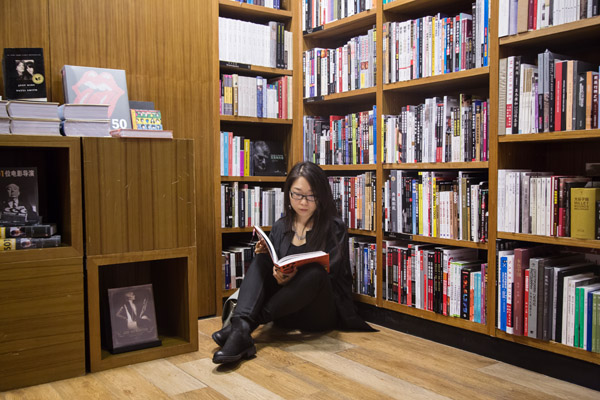
Long hours, low pay and little in the way of recognition, the life of a literary translator was once as exacting as it was precarious - but all this looks set to change as the industry continues to bloom, Yang Yang reports.
At 7 am, He Yujia, a 32-year-old freelancer from Chengdu, Southwest China's Sichuan province, gets out of bed. She immediately goes to her study, and sits in her Okamura chair to translate a book for two hours before breakfast, and after that, for another six to 12 hours.
Earlier this year, three of her translations were published: the first volume of The Years of Lyndon Johnson: The Path to Power by Robert Caro; Shark's Fin and Sichuan Pepper by Fuchsia Dunlop and Michael Bird's Vincent's Starry Night and Other Stories. She is now working on the second volume of Johnson's biography.
At 7:30 am, Chen Yikan, a 33-year-old book reviewer and translator from Jiashan, East China's Zhejiang province, is woken up by his 3-year-old son. After feeding him and changing his diaper, he quickly grabs his bag and walks out. In a nearby cafe, he orders breakfast as he takes out his laptop, books and electronic dictionary before starting on six to eight hours' work.
Chen returns home at 5:30 pm to spend the evening with his son. He is currently working on Somerest Maugham's Collected Short Stories: Volume 3, after translating the previous two editions. His translation of Edward Aubyn's Dunbar: A Novel is due to be published in August.
At 8:30 am, Zhang Yujia, 32-year-old freelance translator from Guangzhou, Guangdong province, begins her work day. Unlike He and Chen, she prefers to keep flexible working hours and often works until midnight.
She has been translating reviews and books on films since 2004 in her spare time. She became a full-time translator in April this year when she finished translating HG Wells' A Slip Under the Microscope. She is currently working on a children's book.
In 2016, China published over 23,000 book titles from overseas, compared to 8,200 titles in 2012, recent data shows.
As early as the Tang Dynasty (618-907), Chinese monk Xuanzang translated Buddhist classics from Sanskrit into Chinese, helping to promote the development of Buddhism in ancient China. But translations did not really take off until the late Qing Dynasty (1644-1911), when patriotic Chinese scholars and officials sought to save China from imperial interference from countries like Britain and Japan, which were much more advanced in terms of science, technology and social development, through translation.
Over the last century, generations of translators have contributed enormously to the advancement of China's culture, society, economy, politics, science and technology.
"You have to know about others before you can really understand yourself," says Teng Jia-wan, a literature translator from Taiwan.
For Chen Yikan, an important driving force for a nation's development is to embrace ideas from foreign cultures, and encourage people to explore new territory.
"The history of fiction is a process in which different cultures are stimulated by translations. Without translation, modern novels couldn't have developed in such a way," says Chen.
Chinese novelist A Yi says that reading translations of foreign literature has helped him develop his style. His favorite translated works include Fan Ye's version of One Hundred Years of Solitude by Gabriel Garcia Marquez, and Li Wenjun's interpretation of William Faulkner's Absalom, Absalom!
"I didn't start looking for nutrition from ancient Chinese literature until relatively recently. Foreign literature offers me a way to measure how far my writing has progressed," says A Yi.