


The master of translation
Yan Fu's informed adoption and adaptation of modern Western and classical Chinese ideas changed the way a generation thought, Fang Aiqing and Hu Meidong report in Fuzhou.










Creative interpretation
Born the son of a doctor, Yan studied under sophisticated Confucian scholars largely influenced by the Neo-Confucianism from the Song (960-1279), Yuan (1271-1368) and Ming (1368-1644) dynasties.
After his father's death, he enrolled in the Foochow Shipbuilding Institution when he was 14.There, he studied Western science and technology in English, using imported textbooks. The subjects included algebra, geometry, calculus, electromagnetism, optics, thermodynamics and chemistry.
He later entered the Old Royal Naval College in Greenwich, London, where he studied the natural sciences knowledge that is needed to translate Western books. He valued research methods like specialization, generalization and experimentation.
Yan continued to read English books and newspapers for the rest of his life. He stressed that advanced scientific and technological knowledge at the time was mostly written in Western languages, resulting in the need to learn them to be able to read Western newspapers and journals in their original languages.
His fellow townsman and classmate Sa Zhenbing (1859-1952), a renowned navy commander, once said that Yan read a lot, and some books over and over again, learning parts of them by heart and summarizing his reflections.
Yan compared and selected titles from his "mental shelf" before deciding which to translate, and which should be translated first, Sa added.
When Yan returned from the United Kingdom, he continued to study classical Chinese culture and thinking with renowned Confucian scholar Wu Rulun, a representative of the Tongcheng school of literature, which is known for practical, well-structured, simple and elegant essays. He also took the keju (imperial civil service examinations) four times, but failed each time.
However, the experience left him with a deep understanding of traditional culture and literature, laying a solid foundation for his later success in translating and introducing Western knowledge to China.
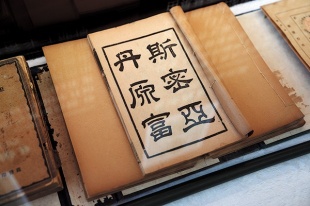
One of his best-known translations is of British naturalist T. H.Huxley's Evolution and Ethics and Other Essays, which advocates Darwin's theory of evolution and natural selection.
He translated the first two chapters, Prolegomena and Evolution and Ethics, and published them in 1898 as Tianyanlun (On Heavenly Evolution). More than 30 editions were published over a decade.
Yan avoided translating word by word, and when paraphrasing a text, he allowed it to serve his purpose of raising awareness of the country's crisis, says Wang Gangfeng, a professor at Fujian Normal University's School of Marxism, who attended a commemorative event to celebrate the 170th anniversary of Yan's birth in Fuzhou on Jan 5.
In his translation notes for Tianyanlun, Yan quoted British sociologist Herbert Spencer's thinking on social Darwinianism to complement Huxley's views, arguing that weak countries should strengthen themselves, and fight and not wait for their demise. In the end, "the one that's most adaptable to change survives".
Yan's translation, with its elegant prose and rhythm, belonged to the writing style of the pre-Qin period (before 221 BC), a time of prosperity in thought. The era remains a profound source of thinking today.