Japanese PM diplomatically incompetent









Japanese Prime Minister Sanae Takaichi's remarks have come like a bolt from the blue. During the Nov 7 session of the House of Representatives Budget Committee, while responding to a question about a "contingency" in Taiwan, Takaichi hinted that this could amount to a "situation of existential crisis" for Japan. Although her statements till then had followed the script prepared by defense bureaucrats, this particular phrase was not in the official response.
As she wrapped up her answer, Takaichi repeated former prime minister Shinzo Abe's words that "a contingency in Taiwan is a contingency for Japan". Defense bureaucrats who drafted the prime minister's responses must have been shocked. They were probably scratching their heads, trying desperately to figure out how to cover up the blunder.
The phrase "situation of existential crisis" appears in the three security documents of Japan, but does not refer to a specific location or scenario. It is considered a taboo to say the phrase openly, because doing so effectively means that the deployment of Japan's Self-Defense Forces is unavoidable.
Using words that amount to a de facto threat of war against a country with which Japan maintains diplomatic relations is malicious and absolutely unacceptable. Such rhetoric jeopardizes bilateral relations, stokes suspicion of Japan among the Chinese people and fuels anxiety among Japanese citizens. Intimidating China only undermines Japan's own security.
Under pressure from home and abroad, Takaichi later issued a carefully-worded expression of reflection, saying that she would refrain from commenting on the matter in the Diet in the future. However, that's not enough. Unless her remarks are officially withdrawn, they will not simply disappear.
The real question is: why were such consequential words spoken at all? Was it a deliberate move to provoke China, or did the prime minister speak without realizing the danger encoded in her words? Her true intent remains unclear.
What is clear, however, is that the Japanese prime minister's diplomatic ineptitude stands fully exposed. This was the first display of the hawkish tendencies that many feared would surface. In her zeal to project strength and "protect the nation and its people", Takaichi has severely undermined the safety of Japan and its citizens.
The Japanese prime minister lacks basic knowledge of diplomatic and defense policies. She had no idea her remarks would trigger distrust and caution toward Japan, not only in China but across Asia. Even former prime minister Abe refrained from specifying what constituted a "situation posing a grave threat to the nation's survival". She considers Abe her mentor, but failed to follow his careful approach.
The reckless remarks call into question Takaichi's suitability as a national leader. She rose to the highest position of power by focusing on domestic politics, but she lacks experience in diplomacy and defense policies that require meticulous consideration of relations with other nations. It seems in her attempt to win favor with hawks in Japanese politics, Takaichi disregarded the broader implications of her remarks.
It is deeply regrettable that, despite the need to portray Japan as a peaceful nation and cleanse its image as a former aggressor state, regressive movements have started in recent years. The Constitution of Japan renounces collective self-defense and the resolution of conflicts through the use of force. So the "three security documents" that explicitly state the possibility of a preemptive strike against other countries are, in fact, violating the Constitution.
Furthermore, the United Nations Charter not only prohibits acts of war against UN member states but also prohibits threats. Takaichi's remarks suggested acts of war against China and constituted a threat. They went beyond the conventional theory of deterrence and amounted to provocative behavior. It is only natural that China responded with full-blown anger.
One can only hope that Takaichi realizes her mistake. She said she will refrain from making such remarks in the Diet in the future but will not retract them, possibly because that would mean admitting her diplomatic blunder and could potentially threaten her continuation in office. But refusing to correct course will be another diplomatic misstep.
The clumsy attempts to cover up the blunder have made matters worse. The excuses offered by the Japanese government are contradictory. Japan has repeatedly stated that it hopes the Taiwan question will be resolved peacefully through dialogue. On the other hand, its prime minister assumes a Chinese "military invasion", calls it a "situation that threatens our existence", and hints at armed deployment in case of a "possibility".
Given these contradictions, one cannot help but doubt the real intent of the Japanese government. If the government wanted to maintain a "consistent position" on the Taiwan question, Takaichi would not have uttered those remarks. To uphold that position, her statement must be retracted.
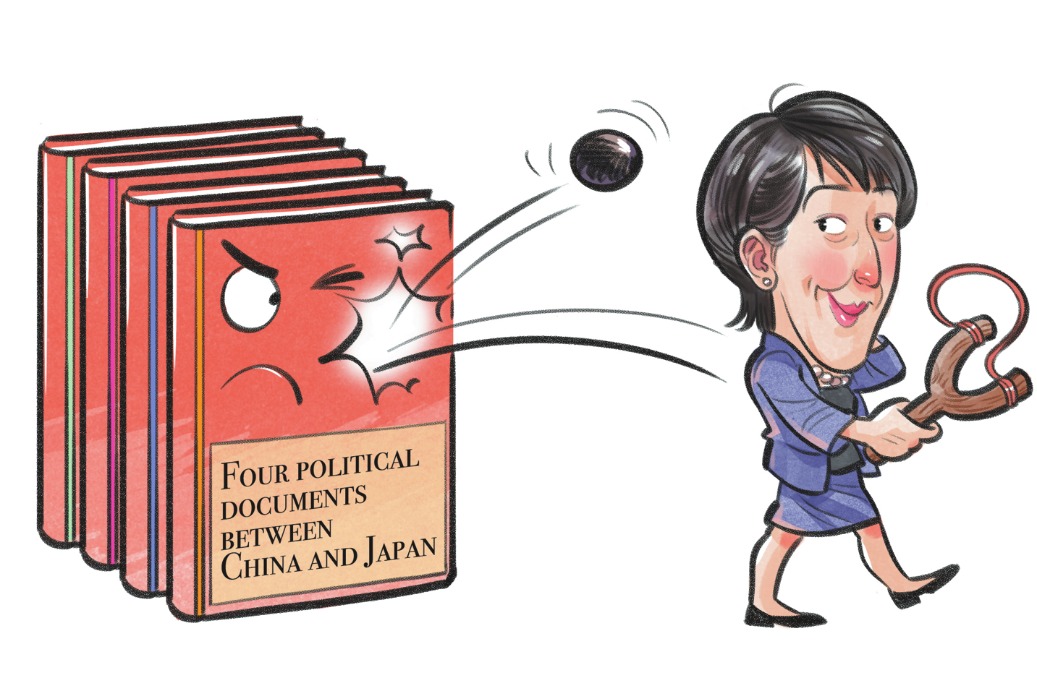
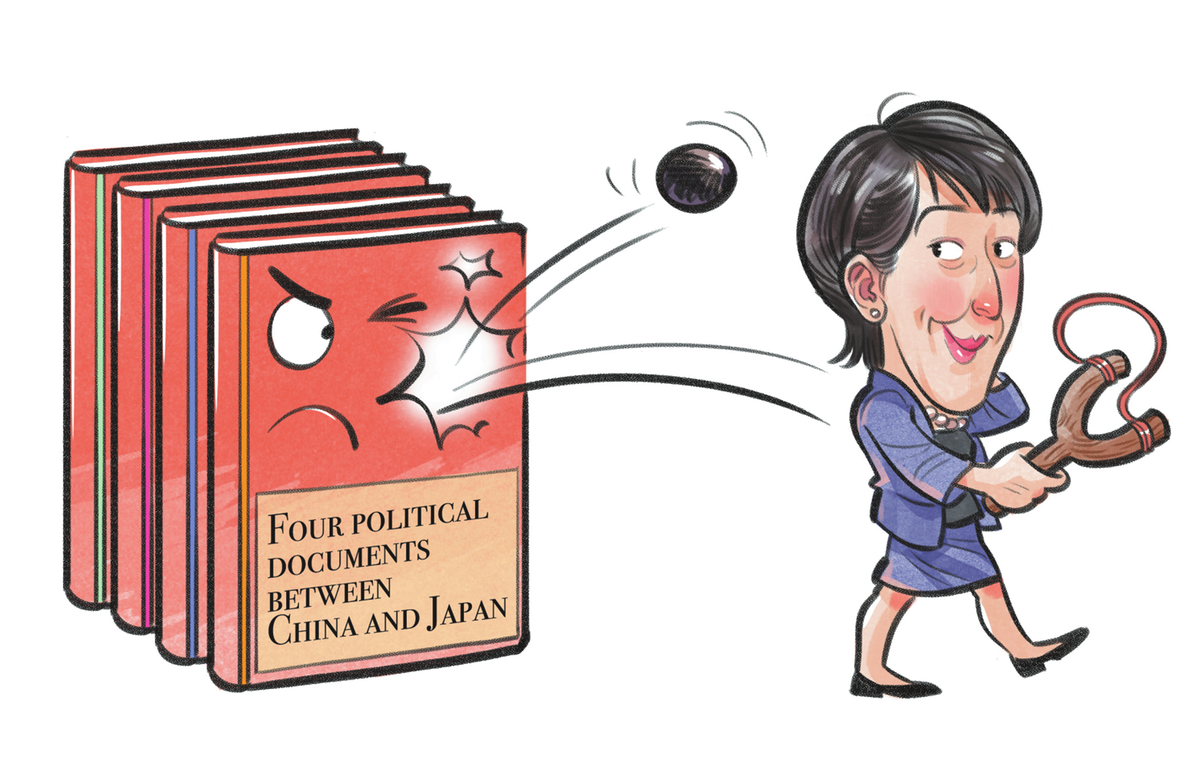
Meanwhile, the following steps are essential to put bilateral relations back on track. First, Japan must reaffirm its commitment to the four important documents between Japan and China, which are the bedrock of bilateral relations between the two countries. The documents recognize Taiwan as part of Chinese territory. The cross-Strait situation is an internal affair of China and any implication that Japan has a say in China's internal affairs violates the spirit of the four documents which are legally binding.
Second, suggesting the possibility of Chinese "military action" against Taiwan is provocative and not only disrespects a diplomatic partner but also undermines trust. The current episode is a diplomatic failure of the Japanese government. The Chinese Foreign Ministry spokesperson Lin Jian's criticism of Takaichi's remarks is entirely justified. Japan should not respond with excuses but offer an apology.
Third, Japan must return to the foundations of its China policy. Besides the 1972 China-Japan Joint Statement, the 1978 Sino-Japanese Treaty of Peace and Friendship promoted stability in Asia by fostering peace and friendship between the two countries. The China-Japan Joint Declaration On Building a Partnership of Friendship and Cooperation for Peace and Development of 1998 reaffirmed the 1978 document and the 1972 Joint Statement as the pillars of bilateral relations. The China-Japan Joint Statement on All-round Promotion of Strategic Relationship of Mutual Benefit of 2008 pledged that both countries would sustain a "strategic mutually beneficial relationship".
These four documents constitute a durable architecture for peace, cooperation, and mutual development. It is disturbing to see that this mutually enriching bilateral relationship, established through decades of cooperation, is being shaken by the remarks of one irresponsible individual. The Japanese government should pull the ties with China back on the right track and prevent the relationship from further deteriorating.
The author is professor emeritus at Yamaguchi University, Japan.
The views don't necessarily represent those of China Daily.
If you have a specific expertise, or would like to share your thought about our stories, then send us your writings at opinion@chinadaily.com.cn, and comment@chinadaily.com.cn.