Performances of traditional music and dancing are helping to raise living standards in an isolated settlement, as Hou Liqiang and Yang Jun report from Fanpai, Guizhou province.
Things are peaceful at night in Fanpai village. The only sounds are the babbling of water in the stream and the occasional bark of a dog. There are no streetlamps, so only moonlight and the ambient glow from a few homes illuminate the settlement in Taijiang county, Guizhou province.
Only one small corner of the village provides a contrast, the cultural center, where groups of residents often gather for discussions that often last until long after midnight.
Nobody can remember exactly how many discussions have been held, but the topic is always the same: finding a proper development mode for the village, which is famed for its cultural heritage but is mired in poverty.
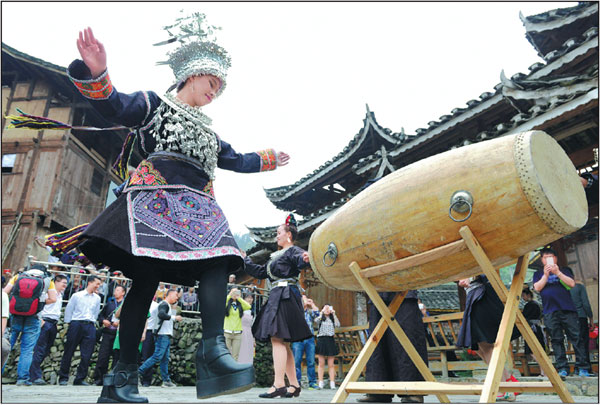
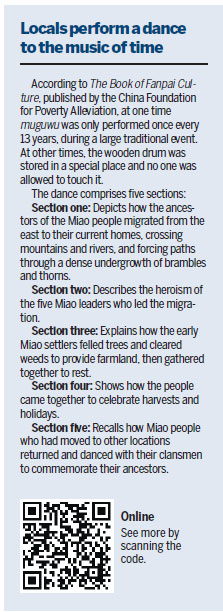
Since the 1990s, Fanpai has been renowned for its rich cultural heritage, including muguwu, literally "wooden drum dance" after the mugu drum, together with multivoiced love songs. They are listed as national cultural heritage. The dance, which records the migratory history of the local Miao ethnic group, has been performed for tourists domestically and overseas, according to Wan Dexue, Fanpai's former Party chief.
Fame has failed to bring major changes to the village. Most of the young people have left to work in big cities, and if the China Foundation for Poverty Alleviation had not arrived in 2013 to help the development of tourism, the village would have vanished, he said.
According to the village committee, 115 of Fanpai's 2,009 residents live below the national poverty line, which was 2,952 yuan ($443) last year.
With 10 million yuan donated by China Minsheng Bank Corp in 2013, the foundation launched a project to help eradicate poverty by developing local tourism. A tourism cooperative was established in 2014, and each of the 20 groups to which residents belong can elect one or two representatives to be members of the cooperative's council, according to Wan, who is director of the council.
The foundation covers the council's operating costs and all profits are distributed among the villagers.
It's not unusual to see outsiders controlling the tourist industry in many ancient villages. However, those responsible for Fanpai's development are determined to allow the villagers to be the dominant force in tourism development to ensure the local culture is preserved.
When the foundation invited Liu Zhaofeng, head planner of Guizhou Architectural Design and Research Institute Co, to design plans for Fanpai, he initially refused because he thought a village as well-known as Fanpai would be too commercialized. Liu had visions of other renowned settlements, which are littered with traditional buildings damaged by poorly designed upgrades.
"However, when I arrived in the village, I discovered I was wrong. Though famous, it hasn't been developed much," he said.
Fascination
Liu decided to accept the offer and found a company that teaches residents how to raise their village's profile and change their own destinies. He asked just 1 yuan for the task, because he was fascinated by the village and wanted to devote himself to its development.
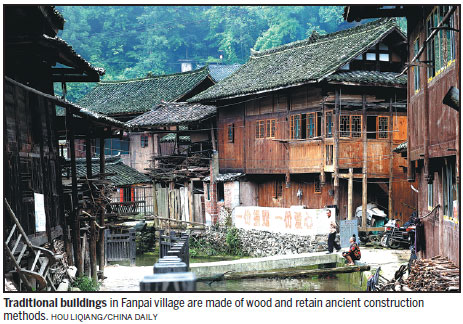
In many ancient villages, planning and construction are undertaken solely for the benefit of tourists, Liu said. Instead, he took the needs of the villagers into consideration and planned the cultural center, construction of which began in 2014 and ended in May.
The center includes one room where the lusheng, a traditional Miao reed-pipe, is displayed and another where the history of the village is the centerpiece. The center also provides a gathering place for traditional events.
"The older generation is confident about their culture, but that's not the case with younger people. They are at a loss, and some are abandoning their traditional culture. At this key time for cultural inheritance, I planned the cultural center in the hope that the younger generation will see their culture when they return and gain confidence from it," Liu said.
The center is a bridge between the villagers and outsiders, and a guesthouse, which opened last month, provides accommodations for tourists, and academics and students researching rural development.
Che Maomao, the foundation's representative in the village, said it has invited Xunmei, a tourism development company that has been running guesthouses in a Miao village nearby, to help run 10 rooms in the cultural center and two recently renovated houses.
Xiao Yifei, Xunmei's general manager, said 30 percent of the revenue from the guesthouses will be given to the cooperative and the company will cover all the operating costs.
Irrespective of whether Xunmei makes money from the project, it guarantees the villagers a payment of at least 100,000 yuan a year.
"We are unlikely to make money from this project, but we hope we can set an example and prompt the villagers to start their own guesthouses," he said, adding that locals will be employed at the center's guesthouse as training to open their own.
Xiao's father left his hometown in Hunan province and spent more than 20 years teaching in a nearby county that is a center for Miao culture.
That commitment bred a passionate attachment to Miao culture in his son, which is why Xiao is determined to contribute to Fanpai's development.
"We hope we can help the villagers to gain skills and make money through their own efforts," he said.
Xunmei has now signed a three-year contract with the cooperative, which should be enough time for the residents to learn the skills needed to run their own guesthouses.
The cooperative has been in existence for three years. It mainly caters for tourists who visit to watch cultural performances or experience rural life. However, the money generated - several thousand yuan - isn't enough to run the guesthouse, so Xunmei can provide help by bringing more tourists to the village, according to Wan, the council director.
History through song
The development of tourism has brought high hopes to the local people, who long to see the younger generation return and preserve and then pass on the traditional culture.
Wan Zhengwen, who has officially been named as an inheritor of two of Fanpai's national cultural heritages, said it has been difficult to pass on the old knowledge and songs that record Miao history, mainly because the ethnic group doesn't have a written language and its history is recorded through song.
"Most of the young people have left the village for work. I visit the primary school to teach the children about our culture, but when they graduate, they will leave the village for further education," he said.
Change may be on the horizon, though. According to Wan Zhengwen, as more tourists have arrived, some of the younger people have expressed an interest in learning from him. "Many people have told me that if they had known tourists were interested in our traditional culture, they would have learned from me," he said.
Yang Guangzhong and his wife performed muguwu across China, and in France and Portugal, for more than a decade. However, in 2013, Yang contracted pleurisy and was forced to give up dancing.
He said the villagers have benefited from the cooperative's work by selling homemade wine, pork and other agricultural produce, and he has high expectations of increased success.
"We used to perform the dance outside the village. Many of the young people still do, but that's just for local dignitaries and bosses. If more tourists visit, the younger villagers will return and we will dance to promote the development of the village," he said.
Between 1995 and 2013, Zhang Xingrong performed muguwu at locations nationwide. Although the 46-year-old privately considers himself too old to perform the dance, he is willing to continue until tourism has developed to a point where it becomes profitable for the young people to return.
"Muguwu has been passed down for generations in the village. If we don't develop tourism, it will either be lost or only performed in other places."
Contact the writer at houliqiang@chinadaily.com.cn
|
A tourist dresses in Miao traditional costume as she learns muguwu in Fanpai village, Guizhou province. Muguwu was listed as a national cultural heritage in 2006.Yang Wenbin / Xinhua |
(China Daily 08/24/2017 page6)