At a high-end restaurant deep in the heart of Jingdezhen — China's porcelain capital in Jiangxi province — the diners sitting round a giant revolving table have met their match.
Among the dollops of carefully simmered dumplings rolling by in their encased bamboo baskets there's a sizzling pan of the most divine duck that crackles and pops.
Then the most anticipated event of the evening arrives. The crowd of distinguished guests hushes. All eyes are on the latest addition to the most exquisite dinner: the pairing of food and drink — the Ferrari of baijiu: Kweichow Moutai.
 |
|
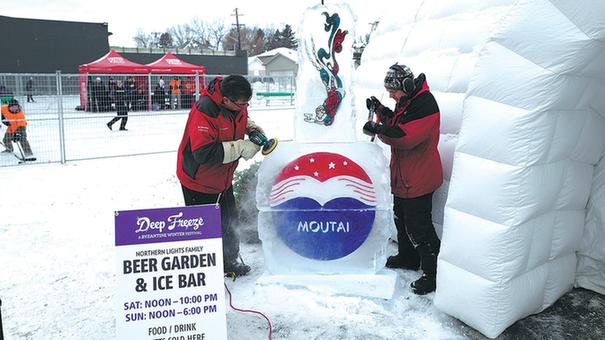
Kweichow Moutai sponsors the winter Deep Freeze Festival, which features an ice sculpture, in the city of Edmonton, Alberta. PROVIDED TO CHINA DAILY |
baijiu is an inspiring beverage that's been intoxicating connoisseurs of high spirits for centuries. The strong baijiu fan base in China also means it's the best-selling liquor in the world.
Here in the capital of porcelain, resting on a gleaming porcelain handled tray, the non-descript every-day looking opaque bottle empowered with its logo of flying fairies, stood like a phoenix rising from the ashes.
We watch the extremely precious clear colorless liquid splash its invisible watery tone into a shot glass. One 106-proof (53% alcohol) 500 milliliter bottle sells for roughly $300. My gracious hosts had thought of everything.
Get ready for countless calls of "Bottoms up!" and be prepared for the seemingly bottomless glasses of the stuff. As the distinguished VIP guest, on a visit to explore the Maritime Silk Road, my clear duty in Jingdezhen was to imbibe in a celebratory toast what is revered as China's finest drink.
Kweichow Moutai is one of the most widely consumed hard liquors in the world. The art of drinking the top-shelf baijiu brand, which is a distilled Chinese alcoholic beverage as I discovered, is vast and varied as the many different ethnic groups in the country.
It takes five years to produce one bottle of Moutai due to the laborious, time-honored process of distillation and aging. Moutai is distilled nine times and then aged three years in ceramic pots.
The most expensive bottle was one from star-labeled Moutai made in 1955, which recently fetched a staggering price of 1.26 million yuan ($198,576). Moutai offers an exceptionally pure, mild, and mellow soy sauce-like fragrance. The box is nothing exceptional, as is the white opaque bottle which bears the logo of two flying fairies.
Although other grains may be used in baijiu manufacturing, the clear drink of Kweichow Moutai, targeting at the high-end market, is distilled from fermented sorghum and comes in 53% and 43% alcohol content.
In southern China, baijiu distillers often use glutinous rice, while the northern Chinese varieties may use wheat, barley or millet. The jiuqu, a Chinese dried fermentation culture used in the produc-tion of baijiu mash, is usually made of pulverized wheat grains.
Noble national spirit continues to work its peerless magic, uniting locals and foreign visitors
It is believed that the town of Maotai in Guizhou province possesses a unique climate and vegetation that contributes to the taste of Kweichow Moutai. Over the years China's official state banquets have served this baijiu to distinguished guests and world leaders, such as US former president Richard Nixon during the state banquet for the his visit to China in 1972.
Zhou Enlai, the first premier of the People's Republic of China, once told Nixon that Moutai had been famous since it won recognition at the Panama Pacific International Exposition in 1915 in San Francisco, and that during the Long March in the mid-1930s, "we used Moutai to cure all kinds of diseases".
Moutai harkens back to the Qing Dynasty (1644-1911), China's last dynasty, which invented advanced techniques for the national drink that have been maintained.
To some, tradition trumps taste. In China, visitors can explore the art of drinking Moutai across the country in a variety of settings, from formal banquet rooms to sampling its lower-grade cousins around some mahjong tables.
One thing baijiu drinkers share in common, however, is the ritual and the aftertaste.
My shot glass filled, I throw back the potent spirit that some have described as smelly socks or liquid dynamite and slam down the empty glass on the table — leaving no trace of the contents except for a film of invisible residue and the strong lingering odor.
Not to alarm my gracious hosts as a self-confessed first-time Moutai tippler, I grin and lightly bow my head to represent deep satisfaction and appreciation of this luxurious hard liquor. I taste flavorful floral notes, sugar cane, with herbal components that are well balanced with dry spices like star anise seed, caraway and licorice root — but the rush of a warming aftertaste overwhelms for what feels like minutes.
The whole process reminds me of drinking the fruity-distilled palinka from my parents' native Hungary, or the anise-infused absinthe that I used to enjoy when visiting friends living in the south of France.
We stand up again, this time one arm behind our back, the other arm raising our shot glass and continue the ritual in an endless round of toasts.
While the birthday was an opportune time to imbibe Moutai, it's especially popular during celebrations for the Chinese New Year. Families gather, friends unite, and distant cousins partake in the New Year festivities — preferably tossing back their heads while taking a big swig of the chest-hair-curling, high-proof potable.
In Fuzhou, Fujian province, at one of the city's finest restaurants, Juchunyuan, diners bellow cascades of laughter as the cavorting mood intensifies with every Moutai toast. Persuading people to drink is a gesture of generosity and "being a good host," says local resident Jenny, describing the favorite national pastime.
My seatmate from Canada scrunches her nose, closes her eyes, and winces before the next chugging toast. "Many foreigners find this drink too strong," Jenny says of the peerless baijiu luxury brand.
In Plum Village in Fujian's Mount Wuyishan area, old gents whose fathers most likely commandeered the thimble-size glass in toasts to the founding of the People's Republic of China in 1949, cast glances at us that could slay dragons as our group of Western visitors idle past them.
Perhaps they nurse a secret. I duck inside their dimly-lit cramped den, with its boxes of tea stacked like the Great Wall of China, and in the corner spot the possible reason for their toothless grins: bottles of Bichun Jiu, which means blue-green spring liquor, the Moutai derivative which is nicknamed "little Moutai". Around since the 1960s, the flavor profile of Bichun Jiu has been described as retaining the fragrant flavor of the original Moutai.
Back in Beijing, hard drinkers quaff their fill inside the world's first bar dedicated to baijiu — Capital Spirits. Liquor real easy, baijiu is enjoyably simple enough for the newbie to knock back in moderation.
Still, some disheveled patrons stagger out from the premises, very much the worse for wear. Other Westerners can be heard wailing, "I hate this stuff."
Moutai might not be everyone's favorite tipple. But for foreign visitors who are ready to explore true China a taste test of this dragon drink, while not for the fainthearted, is a prescribed tradition best experienced with others.
"Bottoms up!"