|
|
Guizhou's Qiannan Normal University for Nationalities' canteen sells dishes made of agricultural products it purchases from impoverished villages as part of a poverty-alleviation project in the province.[Photo provided to China Daily] |
On a recent dull, drizzly morning, several trucks filled with vegetables-including pumpkins, white gourds, cabbages and garlic-parked in a small square in Kapu town in Guizhou's Pingtang county, waiting to be unloaded by dozens of villagers in plastic raincoats.
The square is a distribution center from which the fresh produce of the village will be delivered to the canteens of colleges and other schools across Guizhou province-after passing strict safety tests, of course.
Official statistics show that there are a total of 17,890 school canteens in the province, serving an estimated 6.2 million students.
The overall amount of food needed each month will cost up to a billion yuan ($144 million) and, if that requirement can be met by the impoverished areas, the money could benefit up to a million people.
According to the Guizhou provincial department of education, schools in Guizhou have spent a total of 1.3 billion yuan during the spring term this year to purchase goods from poor villages, which have been exploring sustainable ways to alleviate poverty in the area.
Qiannan Normal University for Nationalities in Pingtang county is one of the pioneers of the program that regularly orders vegetables from local villages.
"We started to buy produce from poor households in Kapu's Xinguan village early last March," says Chen Zhisong, deputy Party secretary of QNUN.
"We took more than 200,000 yuan to the village, going door to door, yet only spent 10 percent of the budget due to the lack of supply."
To gather the scattered, impoverished farmers and improve the efficiency of the deal, the university located a center where a large market is held at the beginning of each semester. Demand for the categories and amounts of vegetables is posted on the bulletin board in the village, enabling farmers and cooperatives to produce according to the needs of the customers.
"In the past, I could only earn around 1,000 yuan from my pumpkins each year, as I failed to find profitable outlets for them," local farmer Xiong Zuowu says.
 |
|
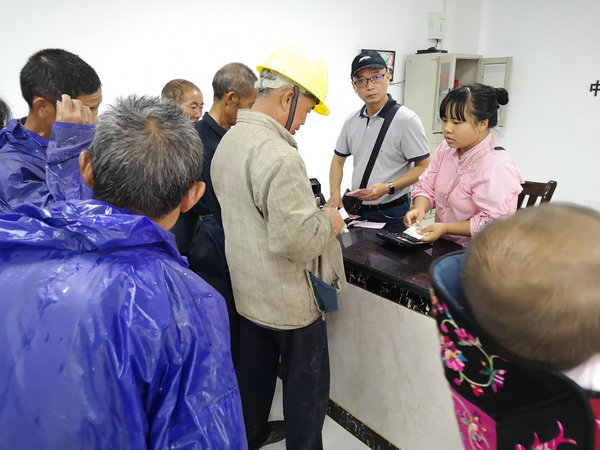
Farmers stand in line to wait the staff from Qiannan Normal University for Nationalities to pay for the products.[Photo provided to China Daily] |
Since signing a contract with QNUN, he sends over 500 kilograms of pumpkins to the university each month. What he has gained from the yield this year will be increased sevenfold.
In September, QNUN launched an online platform for its faculty and canteens to order fresh eggs, bottles of honey and vegetables via an app, which remarkably improved the procurement. The platform will be developed into a service network that supports a nationwide school-farm cooperation.
Thanks to the program, about 4,800 villagers in Pingtang county-1,691 of which are classified as impoverished-increased their annual incomes, on average, by 4,000 yuan last year.
Meanwhile, Guizhou University, Guizhou Normal University, Guiyang University of Chinese Medicine and other colleges and schools in the province have also taken action to bring the vegetables produced in impoverished areas to the dining tables at their canteens at a cost of over 2.19 billion yuan since last September, according to Guizhou's department of education.
Additionally, professors and technicians were also dispatched by these universities to offer instructions and advice on remote villages' agricultural development.
Chen Zhuo, a professor who researches Plant Pathology at Guizhou University, started to help local farmers to raise frogs in wet rice fields in 2016.
"Plots of crops are scattered in the mountainous regions with a cold climate, which leads to a relatively low rice output," he explains. "Frogs can eat pests, and their excretions can serve as fertilizer, so frog breeding will save farmers' costs and boost the rice yields."
The frogs can also be sold to cities, where they are a popular ingredient. According to Chen, the output value of a single mu (0.067 hectares) of land will reach 14,000 yuan if 8,000 frogs are introduced.
Chen and his team are looking to help more people in the region by disseminating the technique to more than 20 counties in the province and training 4,000 local farmers.