Wuhan craftsman revives ancient art of guqin making
Former timber merchant calls it a national treasure









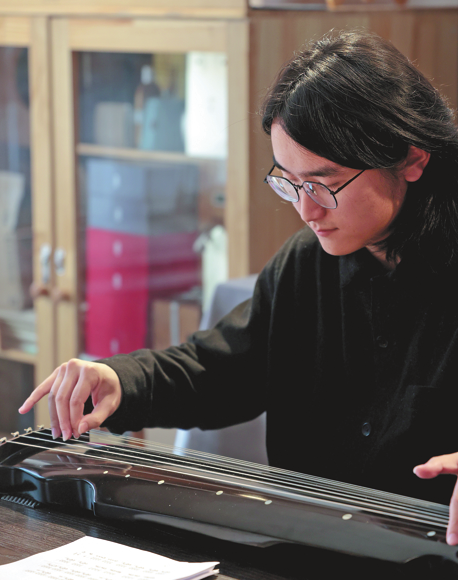
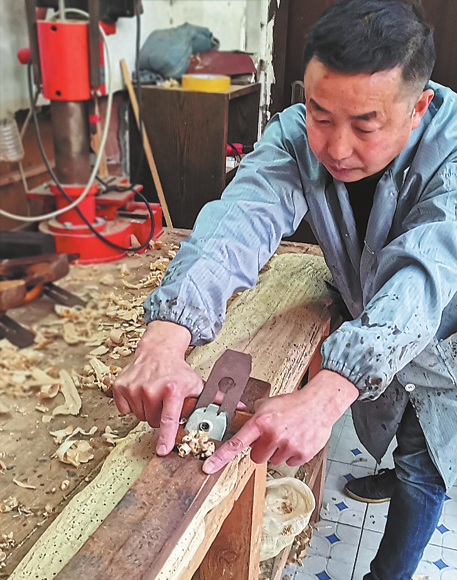
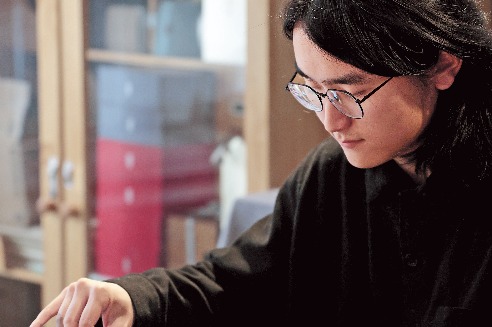
In Jianghan district of Wuhan, Hubei province, Wu Youquan, an inheritor of the intangible cultural heritage of traditional guqin making, has spent over two decades transforming himself from a timber merchant into a master luthier, a maker of stringed instruments.
Born in 1972 in Tuanfeng, Hubei, the craftsman has adhered to the philosophy of "approaching guqin making with the attitude of creating art", becoming a pioneer in reviving the long-lost technique of crafting silk-stringed Chinese parasol-wood guqin.
The guqin is a traditional Chinese plucked string instrument with a history of over three thousand years. It is also known as the "seven-stringed zither" and symbolizes the essence of ancient Chinese literati and scholars.
Wu's journey with the guqin began in 2001. At the time, he was in the business of supplying wood for guqin production when he accidentally discovered that old timber from demolished houses could be used to make the instrument. This led him to extensively source materials from Yunnan, Guizhou and Sichuan provinces.
"Back then, there were very few people in China engaged in guqin making, and I saw the search and collection of guqin materials merely as a means of making a living," he said.
Guqin making is a traditional Chinese craft involving the manual creation of the ancient instrument. The traditional way of making guqin includes cutting or chopping wood with knives or axes and handcrafting it using blades. The entire process includes over a hundred complex steps such as material selection, shaping, woodworking, lacquering, and assembly, taking several years to complete.
However, as Wu's ability to identify aged wood improved, he gradually went on the right track. "I became increasingly fascinated with this ancient instrument that carries profound Chinese culture," he said. Through continuous experimentation, he networked extensively with guqin makers across the country and gained a modest reputation in the community.
In 2010, Wu got an opportunity to serve as a material supplier for a guqin restoration project at the Chinese National Academy of Arts, which completely changed his life's trajectory.
Sun Qingtang, a guqin expert whom Wu had never met, traveled a long distance to find him and recommended him as the supplier of materials needed for the restoration project.
"This precious opportunity allowed me to work with firsthand materials for ancient guqin making and get up close with these treasures," Wu said. To find the most suitable wood, he traveled to remote mountains and villages as requested by the experts, exerting tremendous effort. "I gained a deep understanding of guqin materials," he said.
During his search for the raw lacquer essential to guqin making, he learned that "the best lacquer in the world comes from China, and the best lacquer in China comes from Enshi, Hubei province".
Raw lacquer is a natural resin emulsion harvested from lacquer trees in China. It possesses properties such as resistance to corrosion and wear, and insulation, making it a crucial material for crafting lacquerware and artistic products.
However, the path of Wu's guqin making was fraught with challenges. In order to collect raw lacquer, he traveled to remote mountains and once suffered full-body rashes due to an allergic reaction to the natural liquid paint. While venturing deep into Enshi for the finest lacquer for the restoration project, Wu became integrated in the lives of the local villagers. While obtaining long-term exclusive supply rights for high-quality lacquer, he also built strong friendships with the lacquer farmers.
What made Wu more grateful during his guqin making journey was that his master Sun generously adopted him as his disciple, imparting all his lifelong knowledge to him. Under Sun's guidance, Wu's practical experience and theoretical knowledge were "systematically enhanced".
His wife, Gan Wanxia, is a third-generation inheritor of the Sichuan school of guqin playing. Over a decade of relentless effort and meticulous guidance from her teacher, she has inherited the Sichuan school's playing style. "Advocating for adopting and learning the characteristics of different schools, and drawing on the strengths of multiple styles are key to guqin players," she said.
Their son, Wu Ming, learned guqin making techniques and performance skills from a young age. He later enrolled at East China Jiaotong University to study music theory. During his university years, he conducted research on the project "Traditional and Modern Guqin Making Techniques", receiving guidance from several renowned guqin masters and support from his father.
Today, the family runs a guqin studio in Wuhan, not only hosting elegant gatherings and offering courses, but also collaborating with communities and cultural centers to provide public welfare classes.
"As a new-generation guqin maker, the mission of my remaining years is to pass on this national treasure," Wu Youquan said.
Contact the writers at weiwangyu@chinadaily.com.cn